30 Best Business Ideas and How to Start
The most successful business ideas involve addressing a problem for customers you can reach, at a price that covers the cost of the work involved. For a person who is starting out as a founder, this usually means be...





The most successful business ideas involve addressing a problem for customers you can reach, at a price that covers the cost of the work involved. For a person who is starting out as a founder, this usually means beginning with a specialized service, a limited range of products, or by setting up a local business that they can try out before incurring large expenses.
Just because an idea is popular doesn't mean it is a bad one. A cloud kitchen must have reliable production and delivery. An online course must have paying learners. A repair business must have technical competence and customer trust. Nothing becomes viable merely because its industry is expanding.
The following examples relate to professional services, education, food, creative work and practical local needs. In each case there is a possible customer, a reasonable starting point, and a constraint that is worth looking at. They are suggestions for investigation, not a global ranking of profitability.
What is there that makes a business idea worth pursuing?
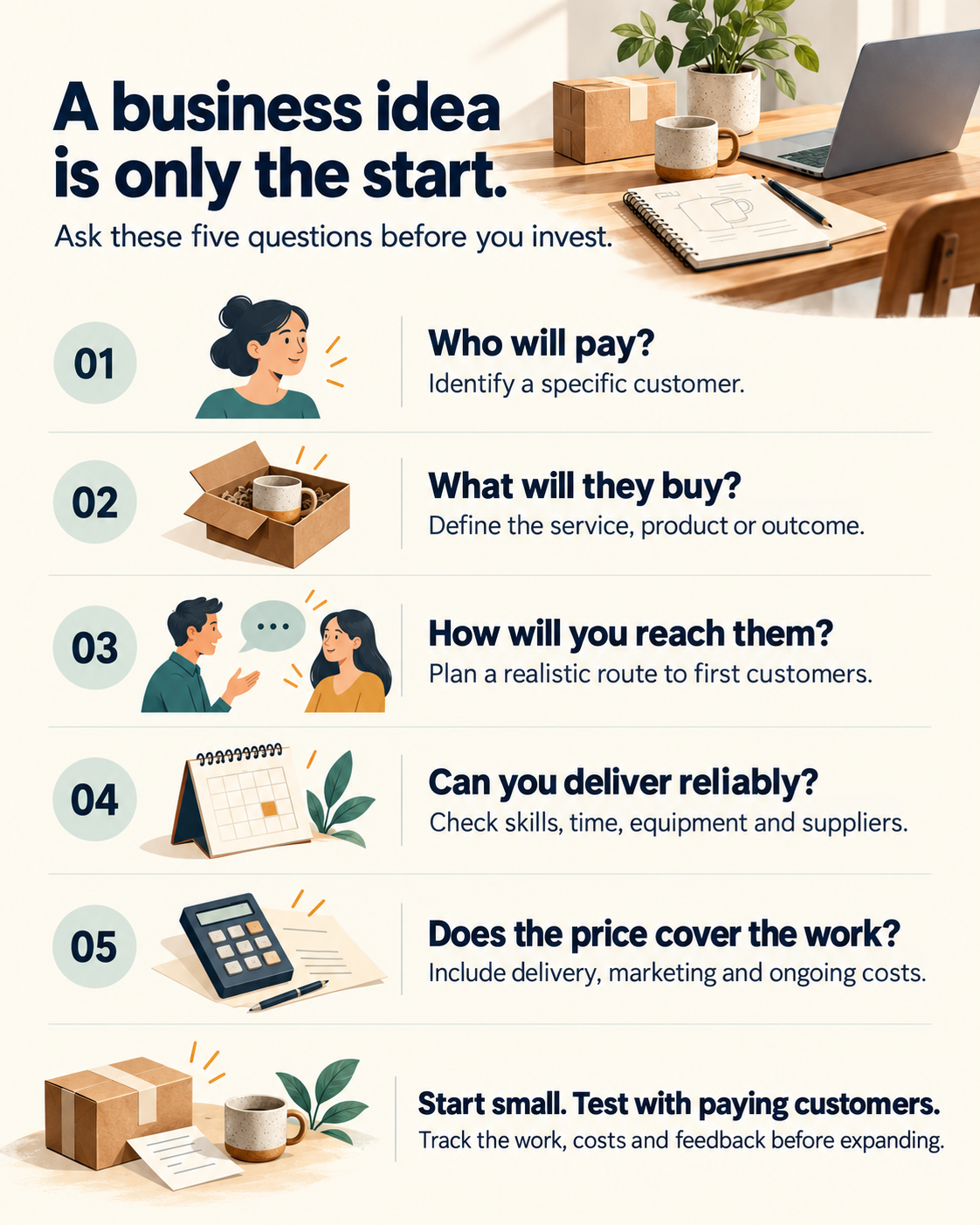
Before choosing an idea, answer five questions:
- Who is the payer? For example, small manufacturers, working parents, or independent retailers.
- What are they purchasing? Describe a deliverable or outcome that they understand.
- How will you get in touch with them? Give a realistic route for reaching your first customers.
- Can you ensure reliable delivery? Consider your abilities, the amount of time you have, the equipment you have, and your access to suppliers.
- Will the price include all the costs? You must take into account your labor, customer acquisition costs, correction expenses for corrections, and the ongoing expenses.
The Small Business Administration suggests examining demand, market size, location, the degree of saturation, and the prices that customers pay for alternative products be examined. Although these questions are useful in any market, the Administration's programs and administrative guidance are specific to the United States. Small Business Administration
Competition should be interpreted carefully, since several existing businesses show that demand already exists. The fact that there are no competitors does not mean that there is an underserved market or that people do not value the service enough to buy it.
Business ideas you can start with professional skills
Such businesses often start off without having a dedicated place of business or without holding a large amount of stock. The main challenges are gaining people's trust of people, clearly defining the kind of work you do, and securing customers.
1. Preparation of your resume and LinkedIn profile
Target a specific group, for example, healthcare professionals, engineering managers, or those who are entering a certain employment market.
Begin by clearly defining the scope of the package clearly: this should include an intake interview, the candidate's resume, their LinkedIn profile, and a mutually agreed-upon revision process. Understanding the industry helps you to better interpret the responsibilities and present relevant experience.
The challenge is maintaining factual accuracy while improving your position, and you must never guarantee interviews, job offers, or a guaranteed score in the applicant tracking system.
Manage social media within one industry.
Provide content planning and account management services in a field that you know well, such as the hospitality industry, recruitment, or professional services.
A single pilot could manage one platform, adhere to an agreed publication schedule, and conduct a monthly review. It should be stated whether photography, comment moderation, and advertising are included.
The greatest risk is that the scope will not be properly controlled. Clients might expect all of the following services—content creation, lead generation, customer service, and sales support—to be included under a single low monthly fee. It is necessary to clarify the responsibilities before agreeing to take on the work.
3. Website maintenance and content update services
Keep the current business websites up to date by updating the pages, checking the forms, managing backups, and arranging the software updates.
Start by reviewing websites that use a single platform you are familiar with, note their current state before making any changes, and agree on a procedure for handling urgent requests.
While regular work can be carried out, a maintenance contract may be costly if it covers an unlimited number of repairs. Keep routine updates separate from redesigns, malware recovery, and any major technical changes.
4. Offer Consultancy Services
Offer support to consultants, property businesses, or small agencies with regard to scheduling, document organization of documents, inbox management, and carrying out routine follow-ups.
Instead, take on a single, repeatable responsibility rather than agreeing to handle all the administrative tasks. This way, training and pricing become easier to manage.
Having access to client information means that you have a serious operational duty in terms of operations. You should set permissions, secure access to the account access, and establish written limits. Administrative support must not turn into regulated legal, medical, or financial advice.
5. Bookkeeping and Account Management for Small Organizations
Offer small businesses transaction recording, invoice tracking, and regular account reconciliation, provided that your skills and knowledge of the local regulations allow you to do so.
Select a group of customers who have similar transaction patterns and software needs. It is easier to provide a dedicated service than to deal with a variety of different businesses from the beginning.
Differentiate between bookkeeping and providing tax advice, as well as auditing and other regulated services—prices should be set prices based on transaction volume of the transaction, the level of complexity, and the condition of the records you receive.
6. Translation Services
Prepare translations of business materials for a language pair and a subject area that you understand well.
The services you can start with are product descriptions, information concerning hospitality, customer support content or training materials. Localization also entails adapting terminology, formats, and cultural references.
The pricing for general translation is under pressure. Although specialist accuracy can help to strengthen your position, translations in the medical, technical, and legal fields do require the right kind of expertise. You should not take on any work where the possible consequences go beyond your area of competence.
7. Freelance Staffing and HR consultant
Conduct interviews with customers, review competitors' offerings, and analyze feedback for companies that are considering a product or service.
Start by setting a specific objective, for example, finding out why customers stop renewing their subscriptions. Make sure that the research question is agreed upon and that the reporting method is also established.
The importance lies in interpreting the findings. While a small number of interviews can identify problems worth looking into, they are not sufficient for understanding how the whole market behaves—the reports contain conflicting findings and limitations.
8. Setting up the workflow and providing staff training
Set up the tools you already have for booking appointments, for tracking inquiries, for organizing documents, or for managing internal tasks.
Select one workflow and one kind of customer. For instance, set up an inquiry follow-up procedure for a small training company and then train the staff.
The problem is getting the system adopted. Even if it is technically sound, it can still fail if employees do not use it. Instead of considering the installation to be complete, it is necessary to include documentation, assign ownership, and provide a support period.
Give businesses a clear learning outcome.
Businesses that provide education work more effectively when their customers know what they will learn, how the classes run, and what kind of progress they can expect.
9. Subject tutoring
Choose a subject, examination syllabus, or group of learners that aligns with your area of expertise.
Start with individual lessons or forming small groups. Evaluate where the learner currently is and set definite objectives, for example, improving their understanding of algebra or preparing for an exam.
Just because someone attends class doesn't mean that they have learned; to evaluate progress, you should use suitable exercises and provide feedback. When teaching children, it is necessary to put in place safeguarding measures in place and maintain clear communication with parents.
10. Classes in music or dance
Organize the classes by instrument, the dance style, the age group, or the skill level.
Instead of having a permanent studio, one could start with a rented teaching room or make scheduled home visits on a scheduled basis. You should explain the equipment required equipment, the expectations for practice, and how classes will progress.
How classes are scheduled, and the measures taken to retain students affect whether the business can succeed. Group classes require a sufficient number of suitable learners, whereas individual lessons rely heavily on your available hours. You should take into account travel time, noise restrictions and the need for appropriate premises.
11. Lessons in handwriting and in writing skills
Provide instruction that is suitable to a child's age on letter formation of letters, legibility, writing fluency, or calligraphy.
Start by conducting an evaluation and setting up a clear program; when working with parents or adult learners, specify the particular skills that will be taught rather than giving general assurances about academic improvement.
Ensure the service has an educational focus; if people continue to struggle with writing, they may need assessment by a qualified professional, and you should not promote treatment for developmental disorders unless you have the appropriate qualifications.
12. Workplace communication training
Teach practical skills such as business writing, handling conversations with customers, giving presentations, or communicating in interviews.
A good initial offer covers one aspect of the situation—namely, dealing with customer complaints, preparing brief reports, or giving project updates—and this should be based on exercises that reflect real workplace tasks.
It is hard to assess a general 'personality development' approach, since concrete skills give customers a clearer reason to join and offer a more reliable basis for measuring progress.
13. Practical software training
Teach someone to use a tool that you are competent in using, for example, spreadsheets, design software, or customer relationship management systems.
Structure the training around the work that people need to carry out; a course on preparing sales reports is more specific than one that provides an overview of all the features.
Because software changes and learners start at different levels, it is important to keep the materials up to date, set prerequisites, and offer realistic practice exercises. Before committing to a large recorded course, it is advisable to test a live workshop.
Food and product businesses you can test in small batches
Pay attention to production, packaging, fulfillment, and the relevant rules. Even a home-based business has to decide which activities are allowed locally.
14. Order meals in advance or choose a dedicated cloud kitchen
Offer something that meets a specific need, for example, office lunches, family dinner packs, or a regional menu that is available on certain days.
Start with a small menu, set deadlines for placing orders, and limit the delivery area. While pre-orders can help with production planning, waste is still caused by cancellations, and inaccurate forecasts still cause waste.
Calculate the ingredient quantities, the time it will take to prepare the food, the packaging cost, the delivery charge, and the platform fee. Make sure that the requirements of a food business have been confirmed with the appropriate authority before taking orders.
15. Pickles, sauces or food products of a regional character
Create a small range for those who want a specific flavor, a particular recipe style, or a convenient format.
Before you approach overseas buyers, test the products locally. Before you expand, make sure to pay close attention to batch consistency, packaging suitability of the packaging, the storage instructions, and the shelf-life assessment.
International orders involve additional requirements that are specific to the destination and can create shipping difficulties. A product which is allowed in its home market is not automatically suitable for use in another country, and you should not assume that interest among people in diaspora communities will ensure a profitable export demand.
16. Chocolates made by hand and gifts for special occasions
Chocolates can be offered as gifts for occasions, as corporate presents, or through carefully chosen retail outlets.
Start with a narrow range and use reliable packaging; take photographs of typical samples, and agree on the order deadlines, personalization charges for personalization, and the delivery arrangements.
Temperature control and the time of year influence the model, and customization may require more labor than one might expect. Failed batches, as well as transport and packaging, should be included in the price rather than calculating only the cost of the ingredients calculated.
17. Artificial jewelry and custom accessories
Offer a specially selected range of products for a specific customer or event, for example everyday workwear, weddings or personalized gifts.
Before making a purchase, try out only a few designs and note down which items receive inquiries, sell well, and lead to repeat purchases.
Inventory can end up in designs that are not popular. Before making a purchase, it is important to check the materials, the supplier's consistency, and the product descriptions, and make the conditions for returns and for custom orders clear.
18. Products resulting from repairs, modifications and upcycling
Provide clothing alterations, repair bags, or restore furniture using your practical abilities.
Specializing in a narrow field gives customers a better reason to choose you. Start with jobs where you can estimate material costs, the amount of labor required, and the time it will take to complete them.
Some items which cannot be economically repaired. Before giving a quote, evaluate them and make clear any uncertainty about possible hidden damage clear. Even if you have attractive before-and-after photographs, this does not offset the risk of underestimating the time involved in the work.
Businesses in the area were based on reliability.
For such businesses, punctuality, a consistent level of service, and customer confidence can be just as important as originality.
19. Cleaning the home and in small offices
Select a service type, for example routine cleaning, move-out cleaning or small-office maintenance.
Begin in a small area and draw up a checklist which specifies the work to be carried out. Give separate prices for the deep cleaning and for the specialist tasks.
The margins are affected by travel, delays in access to supplies, and the need for supervision. As you hire more staff, written instructions for dealing with keys, breakages, and customer complaints become more important.
20. Services relating to beauty and grooming on a mobile basis
Offer qualified services either at customers' homes or at premises where appointments have been arranged, provided that local requirements are met.
Start with the treatments that you can safely carry out with easily obtained equipment; a clearly established service area and booking policy can help to reduce unnecessary travel.
You must charge for the entire appointment, including preparation, cleaning, and transportation. It is essential to maintain hygiene, use appropriate products are used, and set clear boundaries are set regarding the treatments offered.
21. Support for older adults that is not medical
Services include errands, accompanying someone to an appointment, providing technology help, and sharing family updates where allowed.
There are good reasons to look into these needs, since the World Health Organization projects that by 2030 one in every six people worldwide will be 60 years of age or older. However, that change in the demographic structure does not mean that there is a demand for, or that such services are affordable in, any particular neighborhood. Begin with non-medical tasks that are clearly defined. Check local regulations, the screening requirements, and the insurance arrangements. For personal care and medication-related activities, a different level of authorization may be needed.
22. The care of pets and scheduled walks
Offer care to owners who need their pets walked, visited, or looked after temporarily.
Start by setting up a small service area and designing intake questions that include information on behavior, daily routines, health details, and emergency contacts. Arrange an initial meeting before agreeing to take in animals you are unfamiliar with. Group walks and drop-offs come with a variety of responsibilities. Before deciding to expand, you should assess your own capabilities, your facilities you have, and your insurance coverage.
Repair of appliances, smartphones, or computers
Select equipment that you are competent to diagnose and repair.
Begin by outlining the various services and clarifying the fees for inspections, the cost of parts, and the turnaround times. Note the condition of the device when it arrives.
Wrong diagnoses, poor spare parts, and repeated faults can damage earnings. When dealing with phones and computers, it is important to handle customer data carefully, ensure written consent is obtained, and restrict access is restricted.
24. Planning weddings and coordinating events
Provide a specialized service, for example, day-of coordination, vendor management, or for planning a specific kind of ceremony.
A more compact coordination package would be a feasible starting point for someone with relevant experience. It is important to establish dependable relationships with vendors and to use written schedules.
Pressure comes from seasonality, cancellations, and last-minute changes. Clarify who has deposited the money, who has the spending authority, and who is responsible in the event of supplier failures. A client's large budget does not mean that the planner will make large profits.
25. Photography at weddings and for business
Select a category that matches your abilities: weddings, property listings, products, or business portraits.
Create a typical portfolio and offer packages that specify the shooting time, editing, delivery, and usage terms.
The visible portion of the session is only a part of the total workload; the costs are also influenced by equipment, travel, file management, editing, and backup arrangements, and the need for contingency planning for important events.
Business ideas for future needs—with buyers to investigate now
Businesses that look to the future appear more credible if they address current spending or a specific operational problem; merely pointing out a trend is not enough.
26. Small-business cybersecurity support
Qualified specialists can provide access reviews, check the backups, carry out basic security configuration, and provide staff awareness training.
It is simpler to assess a specific initial assignment than a promise to make a company secure. The NIST Small Business Cybersecurity Corner offers resources that are specifically aimed at smaller organisations. It is specialist work; you must get written authorization, define the scope, and identify any issues that need to be escalated. You should not provide penetration testing or incident response unless you have the appropriate capability.
27. AI-assisted workflow implementation
Set up tools for a specific task, for example, for drafting standard internal material or for arranging information for human review.
Begin by reviewing the current process and checking whether the suggested approach improves it, including responsibilities for review and a method for handling incorrect outputs.
The benefits may be outweighed by considerations of privacy, reliability, and ongoing costs. Avoid making broad claims about transformation when the real outcome is only a small improvement to the workflow.
Assessment and coordination of EV charging sites
Find out whether property owners, employers, or providers of accommodation providers need help with assessing charging installations.
The IEA's Global EV Outlook examines vehicle deployment of vehicles, the charging infrastructure, and policy differences across markets, underscoring the need for location-specific studies for each location. IEA
A coordination service can start with qualified installation partners. When it comes to owning charging equipment, a separate evaluation of the site's electrical capacity, usage levels, tariffs, maintenance, and site economics of the site is required.
29. Building-efficiency assessment and improvement coordination
A specific building type is a reasonable starting point; however, you must review actual utility data and obtain quotes before making recommendations. Savings will vary by building, climate, tariffs, and occupant behavior. Make sure that the estimates are clear, and verify the qualification criteria for any assessment or installation. Don't base your business around an incentive unless you first check that it is currently available. Don't build the business around an incentive without first confirming it's available.
Begin with a customer group whose needs you understand. Coordinate samples and suppliers. Errors can render the whole batch unfit for use. Find out who approves the dimensions, the artwork, and the information that is legally required information. The demand for packaging does not eliminate the need to control specification and production risks for packaging does not remove the need to control. One doesn't always need a new invention to have a unique business idea. A well-known service can become more relevant by sharpening its customer focus or improving how it is delivered.
For example:
- General tutoring can become maths support for pupils entering a particular examination year.
- Website support can turn into maintenance for independent clinics when they use a single platform.
- Meal preparation can lead to workers in one office district pre-ordering their lunches pre-ordered.
- Meal preparation can become pre-ordered lunches for workers.
A market niche may be either too small or too costly to target.
You should examine the number of potential customers, how often they buy, and whether their budgets can support the work; specificity only improves positioning if enough buyers value it. It provides support for the work. Specificity improves positioning only when enough buyers value it. The costs involved in setting things up include the equipment, registration, the initial materials, and the preparation budget:
- Setup expenses: equipment, registration, initial materials, and preparation.
- Continuing costs include software, rent, utilities, insurance, and marketing.
- Delivery costs include materials, labor, transport, and the payment charge.
- Cash on hand is the money needed when sales or collections are uncertain.
The Small Business Administration recommends identifying your expenses and distinguishing between one-off costs and monthly expenses before moving forward. It is more helpful to obtain local quotations than to treat a published range of start-up costs as being suitable in all cases. Small Business Administration
Consider this hypothetical meal-business example:
The price of a meal is 12 currency units; the combined cost of the ingredients, packaging, delivery, and payment is 8, so that 4 remain for fixed expenses and to pay the owner.
If the total remaining monthly requirement reaches 1,200, the business will need 300 meals from that contribution to meet it. If refunds, waste, or greater delivery costs occur, then the requirement will increase.
First, check capacity—can the kitchen handle that amount, and can the delivery area support the required number of orders? A break-even calculation is only useful when paired with a realistic operating plan.
Test your strongest idea before expanding.
Choose one idea for a controlled pilot. Testing several unrelated businesses simultaneously makes the results harder to interpret.
Speak to potential buyers about recent behavior.
Ask what they currently use, what they pay, and where the experience falls short.
“What happened the last time you needed this?” usually produces more useful detail than “Would you buy my service?”
Avoid relying entirely on friends. Reach people who resemble your intended customers and have no reason to encourage you.
Examine the alternatives
Review relevant competitors’ offers, prices, booking processes, and customer feedback.
Look for recurring complaints you can realistically address. Verify whether the issue remains unresolved rather than assuming an old negative review represents the current service.
Offer a small, paid version.
Examples include a workshop, a limited production batch, or a fixed-scope service assignment.
State the price, delivery date, exclusions, and cancellation terms. A paid pilot provides stronger evidence than compliments alone, though a few purchases still don't prove sustained demand. hostinger.com
Record what delivery actually requires
Track selling time, delivery hours, corrections, expenses, and customer responses.
Decide whether to continue, change the offer, or stop. A pilot that exposes weak economics has served its purpose before you take on larger commitments.
Frequently asked questions
Which business is best for a beginner?
A focused service based on an existing skill is often a manageable starting point. Tutoring, administration, writing, and certain local services allow a smaller pilot than businesses requiring substantial inventory or premises. Your choice should still consider customer access, delivery capability, and applicable rules. Low setup cost does not make an unsuitable service a good business.
Can I start a business with very little money?
Yes, particularly if you already have the equipment and skills needed to deliver a service. However, budget for communication, transport, software, registration where applicable, and the time required to find customers. Starting alongside employment may reduce financial pressure, but check contractual restrictions and whether you can reliably meet customer commitments reliably.
Which business ideas are best for the future?
Investigate needs linked to aging populations, digital operations, security, repair and efficient resource use. Then narrow the investigation to a specific buyer and current problem. A long-term trend may support your reasoning, but customers’ present budgets, alternatives, and willingness to pay determine whether you have a viable starting offer.
How do I know whether my idea is too competitive?
Compare the available businesses with the customers you intend to serve. Examine service quality, prices, capacity, and unresolved needs. Competition becomes especially difficult when buyers see no meaningful difference, and you depend on discounting. Before proceeding, identify a credible reason customers would choose you and calculate the cost of reaching them.
Should I quit my job to start a business?
Make that decision using your financial obligations, available reserves, and evidence from paid work. A successful first sale is encouraging, but does not demonstrate stable demand. Where practical, use a pilot to understand customer acquisition, delivery costs, and repeat business before relying on the venture for essential income. Also assess whether part-time delivery is feasible.
Can a local business eventually serve international customers?
Sometimes. Remote professional services may expand through strong expertise and client relationships, while physical products add shipping, customs, and destination requirements. Language, payment collection, and customer support also matter. Establish dependable delivery in your initial market, then test one overseas customer group rather than assuming worldwide interest translates into profitable orders.