



How Agricultural Producers Can Showcase Their Products Better Online
Agricultural producers often offer top-quality products and deep market knowledge, but their online presence rarely inspires buyer confidence because of unclear or incomplete information.
This is one reason many producers struggle to generate serious inquiries from their websites, Google Business Profiles, or social media pages.
Being online is simple, but many agricultural businesses still struggle to establish buyer trust and engagement through their product presentation.
Why do many agricultural producers struggle online?
Many agricultural businesses still depend on offline networks, referrals, intermediaries, and existing buyers. This approach may sustain repeat business, but it restricts exposure to new buyers searching online.
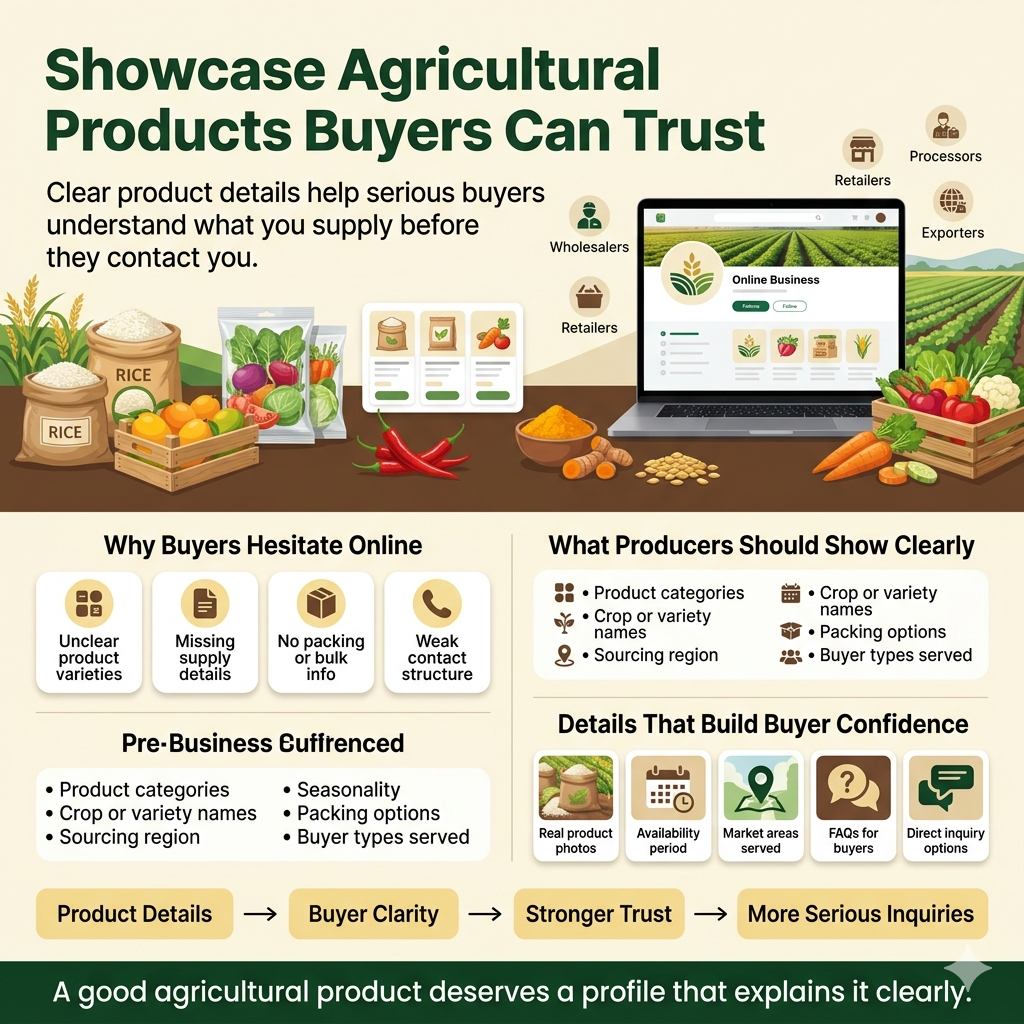
When buyers visit a website or profile, they want quick clarity on what the producer grows or supplies, the product range, sourcing region, seasonality, packaging, supply capability, and typical customers.
Many agricultural profiles lack key details about product range, supply capabilities, and buyer suitability, leading to missed opportunities.
Some websites offer only a brief company introduction, while some social pages show farm images without commercial details. Google Business Profiles may list basic contact information, leaving a gap between the business's strengths and its online presence.
Why showcasing products properly matters
Buyers inquire only when a business’s online presence clearly shows relevance and credibility.
For agricultural producers, this is especially important because their products often need more context than those of businesses in other sectors. A buyer may want to know:
- What varieties are available
- whether the supply is seasonal or year-round
- What grade or quality level is offered
- whether the producer handles bulk orders
- whether packaging or private labelling is available
- Which regions or markets are served
- whether the business supplies retailers, wholesalers, processors, or exporters
If these details are missing, buyers choose suppliers with clearer information.
Why websites often fail to bring enough inquiries
Many agricultural business websites appear professional, but fail to help buyers make informed decisions.
For example, a rice mill website may emphasize quality and customer satisfaction but provide little information on varieties, milling capacity, packaging sizes, buyer categories, or dispatch locations. Wholesalers still can't determine suitability.
A turmeric producer may upload a few product photos and mention “premium quality turmeric,” but without details on the supplied form, packing, sourcing district, or commercial use, serious buyers struggle to proceed.
Websites often introduce the business yet omit the details buyers need.
Why does Google Business Profile also have limitations?
Many local and regional agricultural businesses create Google Business Profiles expecting automatic leads, but incomplete or broad information limits results.
A fruit grower, seed supplier, or organic producer may have a listing, but without a clear product description, useful visuals, service details, or an explanation of commercial relevance, the profile struggles to perform.
This reduces both trust and discoverability.
A business may appear in search results, but without clarity, buyers are unlikely to click or inquire, reducing the profile's effectiveness.
Social media generates attention, but not always buyer confidence.
Many agricultural producers now post updates on social media about post-harvest, fieldwork, packaging, and festivals. This boosts visibility, but visibility alone does not show commercial value.
A mango grower may post attractive harvest images on Instagram or Facebook, but retailers or distributors require more than visuals. They want details on available varieties, estimated supply volumes, packing support, delivery capabilities, and business contact structure. Without those details, content may receive likes but not meaningful inquiries.
Visibility alone is insufficient; agricultural businesses require detailed online product information to secure buyers.
Realistic examples of how agricultural producers can showcase their products better
A red chili producer in Andhra Pradesh may already supply local traders and wholesale buyers, but its online presence may state little more than “reliable chili supplier.” A stronger product presentation would describe the chili varieties offered, the drying techniques used, the packaging options, the supply regions, and the typical buyer types served. That immediately makes the business more appealing to a serious buyer.
A rice producer or miller may have experience, but without details on rice categories, milling strengths, packing sizes, transport, or markets, buyers must guess. A stronger showcase organizes these details so the website works as a commercial introduction.
A mango grower may see strong seasonal demand, but if only orchard images appear online, they miss an opportunity. Buyers need clear details on variety names, harvest periods, packing, market preferences, and dispatch capabilities. Those details add meaning to the profile.
An organic farm brand may describe its products as "natural" and "farm fresh," but buyers expect more substance. They want crop details, supply methods, delivery coverage, served segments, and any certifications. A clearer profile reduces uncertainty.
A seed supplier may have strong farmer trust offline, but if the website or profile does not clearly explain seed types, crop suitability, advisory support, and available categories, the business loses online buyers and dealers with specific requirements.
These examples show producers need clearer product details more than broader offerings.
What should a better online agricultural product showcase include
A good online product presentation helps buyers understand the product and the business.
That can include:
- clear product categories
- crop or variety names
- supply form and packing options
- sourcing or growing region
- seasonality or availability period
- buyer type served
- market area covered
- business photos that support credibility
- FAQs answering practical buying questions
- contact and inquiry clarity
Structured details make your business more relevant, credible, and likely to receive inquiries.
Why does this also support online visibility?
Better product showcasing is not only useful for customers. It also helps search engines better understand the business.
If you do not provide detailed product names, categories, and supply information, search engines receive weak signals. This makes it harder to appear for relevant searches and compete against specific, well-presented profiles.
A well-presented online profile builds trust, reduces reliance on middlemen, and enables more commercial success.
Why do many producers need support beyond their own website?
A website and Google Business Profile matter, yet many businesses don’t know how to build an effective, secure, and consistent online presence to improve visibility.
Building backlinks and digital promotion is harder. Poor or irrelevant backlinks can hurt search visibility. Many businesses avoid it or take wrong steps with little benefit.
Social media has the same issue. Occasional posts are not enough. Consistent, relevant updates bring people back to the business profile or website.
How can White firms help agricultural producers?
White firms help producers provide more clarity than a basic profile or a site alone. Rather than a name and short description, a structured profile explains what's supplied, product categories, regions served, and buyer types.
Enhance your online presence with precise product information. Identify and resolve gaps to attract serious buyers.
White firms support businesses struggling to gain online visibility. Building high-quality backlinks is challenging, and mistakes can weaken visibility. Producer sites and Google profiles both have limits in backlink building.
White firms strengthen listed pages with relevant, high-quality digital support. They expand reach through ongoing social media scheduling and content sharing, bringing repeat visitors. Over time, repeated discovery with a credible profile builds stronger visibility and buyer attention.
White firms are useful not just as a listing platform but also as a support layer for businesses seeking products that are found and understood online.
Update your profile now to help the right buyers find the right producer. Start improving your online presence and make it easier for buyers to reach you.
Agricultural producers often have more value to offer than their online presence reveals. The real challenge is presenting products clearly, helping buyers understand what is available, whether the business is relevant, and why they should contact the business.
A stronger online presence helps reduce confusion, improve buyer trust, and increase the likelihood of inquiries. It also gives agricultural producers a more practical way to showcase their work beyond local networks and away from reliance on traditional trade.
For agricultural businesses that want to attract more direct inquiries, stronger online product showcasing is no longer optional. It is part of how modern buyers evaluate suppliers.