



How Multilingual Business Pages Help You Reach People Globally
Many potential customers can miss out on great businesses if they ignore language differences.
This occurs when businesses use only English while customers prefer other languages. This is a worldwide issue, including in U.S. communities with multiple languages.
A business page in multiple languages removes barriers and expands your global reach. Relying solely on English limits your audience and may erode trust among non-English speakers. Providing information in multiple languages is crucial to staying relevant and connecting with more customers.
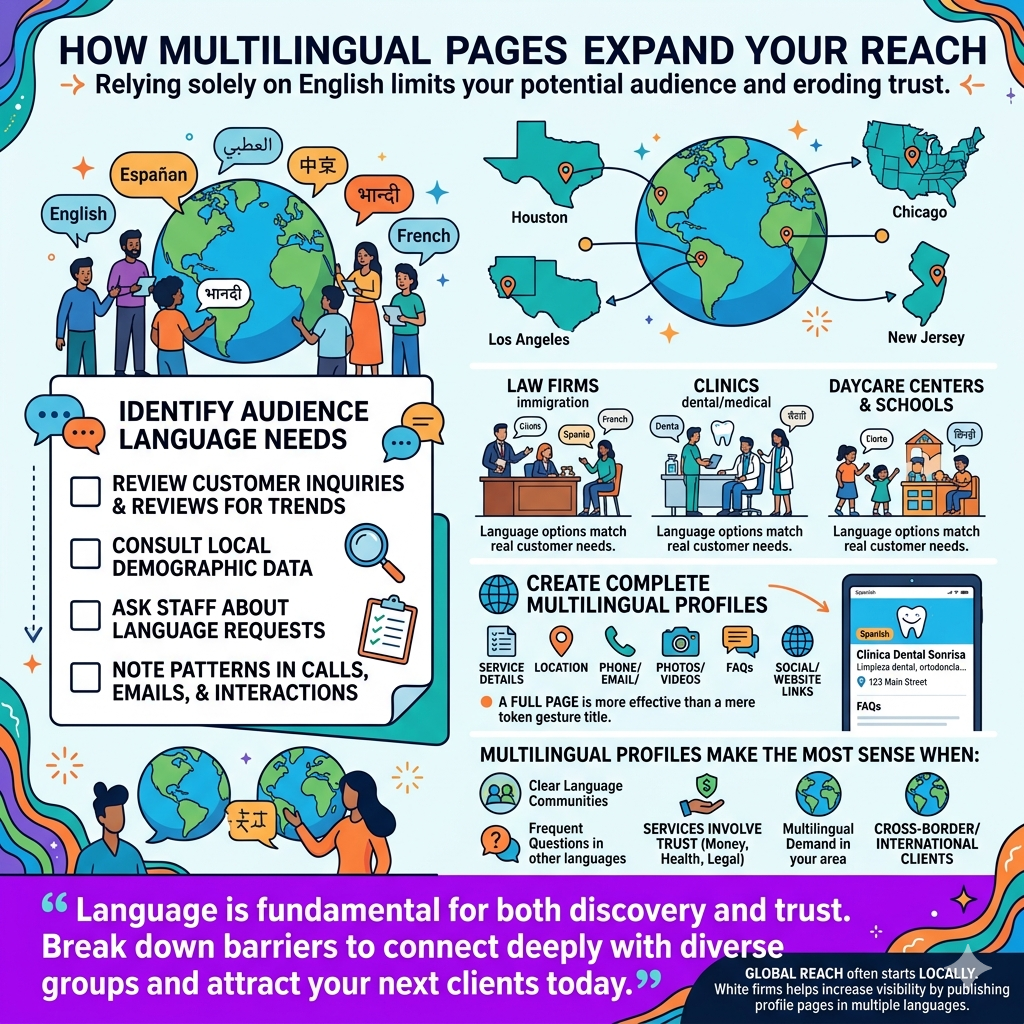
Match language. Choose language options based on what your customers really need. Begin by finding out which languages they use. Examine customer questions and reviews to identify trends. Local population and community information will show which languages people speak. Ask your staff who interacts with customers about common language requests.
Here is a simple checklist you can follow to identify language needs for your business:
1. Review recent customer inquiries, reviews, and questions for signs of language preferences.
2. Consult local demographic data or community information for statistics on languages spoken.
3. Ask your team members about requests they've received in different languages.
4. Note any patterns in phone calls, emails, social media comments, or in-person interactions regarding language.
5. Prioritize languages that consistently appear across these sources. Main point: Focus on translating languages your audience actually uses. This helps you avoid wasting time and money and makes your work more effective.
Why multilingual visibility matters in the first place
Business visibility depends on language, search, ads, and content. Without multilingual options, your business reaches fewer people.
People search for what they know. They judge businesses by how easy the language is to understand. If customers speak Spanish, Arabic, Chinese, French, Hindi, or Korean, offering only English can make your business feel distant—even if your service is right for them.
People may keep browsing, but if service, pricing, location, or FAQs are unclear, confidence drops. Confusion, not dislike, causes hesitation.
Being visible online in multiple languages often determines how well you connect with your audience. It affects both how easy you are to find and how comfortable people feel. Language is fundamental for both discovery and trust. Your choice of languages shapes business results.
Search is only one part of the picture.
Business pages in English may not feel welcoming or trustworthy to everyone. Sharing information in familiar languages builds trust.
This doesn’t mean people only trust businesses in their first language. Many are comfortable with English, but it’s easier to feel at ease when details are clear, especially when making important decisions about money, health, or legal matters.
Someone looking at an immigration consultant, tutoring center, tax helper, lawyer, doctor, wedding service, moving company, or training center may feel more sure if the information is in a language they know. This confidence is practical, not just feelings. People feel better when they understand what’s offered without having to guess.
Using only English limits your potential reach and weakens connections with diverse groups.
You don’t need to replace English, but assuming English alone is enough limits your business’s reach and impact.
Assuming English always works can make your business less visible. Believing English always works can make your business harder to find in searches in other languages and less welcoming to people who prefer those languages. English-only profiles may not appear, limiting visibility.
Others might find your page but struggle to connect if the information is hard to understand because of the language.
Even those who read English well may prefer details in their native language for important decisions.
English-only profiles aren’t wrong, but miss opportunities in multilingual communities. Show your business in more languages for a wider reach.
Main takeaway: Only add languages when you have regular non-English messages, clear survey responses, or data confirming a multilingual audience. This ensures translations meet real needs.
Not every business needs content in multiple languages. Clarify your real needs first.
A local business serving only English speakers may not need translation. Small businesses with few customers should improve their English profile before adding other languages.
Examples include:
- immigration law firms
- tax consultants
- medical and dental clinics
- real estate agents
- day-care centers and schools
- tutoring and training businesses
- moving companies
- travel services
- wellness centers
- senior care services
- legal consultants
- repair and home services in multilingual cities
A real estate agent in Houston, a dental clinic in Los Angeles, a tutoring center in New Jersey, or an immigration lawyer in Chicago may serve clients who speak many languages. For them, multilingual pages are essential tools, not extras.
Pages in multiple languages help clear communication, build trust, and foster connection. Share information in your clients’ languages to gain trust and reach. When people fully understand a business, they trust it more. Trust is often discussed in general terms, but it really depends on whether people can clearly understand, verify, and use your information. Your information.
Can they understand what the business offers? Can they tell if the service is for them? Can they read the details easily? Can they understand how to use the service, where it’s available, and how to contact the business? A bilingual business listing answers questions for audiences who might otherwise feel only partly informed.
A clinic serving many Spanish speakers might have only a brief English description. Some visitors get by, but if the clinic adds details, instructions, FAQs, and contact info in Spanish, the business feels more trustworthy and clearer.
Other service businesses see the same effect. People are more likely to take action when the business is explained in terms they know.
Pages in multiple languages boost engagement by removing barriers and building trust. They help increase visibility and encourage customer action by making information clear and accessible.
- Multilingual business pages should offer more than just a translated title.
- A common mistake is treating multilingual content as a mere token gesture.
- A translated title does little. A full page with service details, contact info, location, FAQs, and visuals is more effective.
- Media, FAQs, and complete business information matter on multilingual pages.
- A strong multilingual business page should ideally include:
- service descriptions in the target language
- location or service area details
- working phone, email, or inquiry form
- images or videos that reflect the actual business
- FAQs that answer likely concerns
- social or website links where relevant
a clear explanation of what the business does and for whom
Remember: Language alone doesn't remove confusion if the page itself is incomplete. Key takeaway: Prioritize clarity and completeness in every language. Ensure your next multilingual page has clear service details, contact info, FAQs, and regularly requested content to truly serve clients.
To make this even more practical, here is a sample outline and template for a complete multilingual business section:
Sample Multilingual Business Page Template:
- Business Name (in target language)
- Short introduction or summary of services
- Complete service descriptions (what you do, who you help)
- Location and service area details (including any local branches)
- Up-to-date contact information (phone, email, messaging apps)
- Hours of operation
- Frequently Asked Questions (with answers)
- Step-by-step instructions for booking, signing up, or contacting
- Visuals: photos, videos, or graphics relating to your business
- Links to website, social media, or reviews (if available)
Here is a short example of what a multilingual section might look like for a dental clinic’s profile in Spanish:
Nombre del negocio: Clínica Dental Sonrisa
Resumen: Ofrecemos servicios dentales para adultos y niños en el área de Riverside.
Servicios: limpieza dental, ortodoncia, implantes y blanqueamiento dental.
Ubicación: 123 Main Street, Riverside, CA
Teléfono: (555) 123-4567
Horario: lunes a viernes, 9:00 am - 5:00 pm
Preguntas Frecuentes:
- —¿Aceptan seguros dentales?
Sí, aceptamos la mayoría de los seguros.
- —¿Atienden emergencias?
Sí, ofrecemos citas de emergencia el mismo día.
Using a template like this helps ensure your multilingual pages meet your audience’s needs and encourage trust and engagement.
Media and FAQs boost confidence for multilingual audiences.
Visuals are valuable on multilingual pages, aiding understanding across languages.
If a training institute shows real classroom photos, course visuals, videos, and service-related images, visitors can better understand the business. If a remodeling company shares project photos and translated service descriptions, the page becomes clear. If a diagnostic center displays facility images and translated FAQs, people may feel less uncertain before calling.
FAQs are especially valuable here.
A person reading in their preferred language may want quick answers to practical questions such as:
- Do you serve my area?
- Do I need an appointment?
- What documents should I bring?
- Are weekend consultations available?
- Which services are offered in person and which are remote?
How soon will someone respond?
When answers are clear and available in a familiar language, hesitation drops and accessibility rises. Review your page and fill any gaps in your customers' languages—complete, clear, relevant information drives real connections. Key takeaway: True accessibility comes from thorough, relevant content in all necessary languages.
Multilingual visibility strengthens businesses equally at the local and global levels—the core principle of reaching more people, wherever they are.
“Reach people globally” sounds grand, but it isn’t just about serving customers worldwide.
Global reach often starts locally. U.S. cities include many language communities. You might serve international students, immigrant families, buyers, job seekers, expatriates, tourists, or those comparing services abroad. Review your business profile and add languages to connect with more people. Don’t wait—start your multilingual update and attract your next clients today.
Some businesses work beyond local borders. Consultants, education providers, immigration firms, trainers, healthcare facilitators, travel advisors, and online services may get inquiries from outside the U.S. In those cases, multilingual pages help explain the business to a broader audience without relying only on English.
The goal is not universal reach through translation alone. The goal is to break down language barriers that limit visibility and trust, resulting in greater business success.
When multilingual profiles make the most sense
Not every business should start with multiple languages right away. The sensible move is to look at audience reality first.
Multilingual profiles make sense when:
- Your audience includes clear language communities.
- Customers often ask questions in other languages.
- Your services involve trust and careful reading.
- You work in cities or industries with multilingual demand.
- You already attract visitors from different language backgrounds.
- Your business serves international or cross-border clients.
- If none of that applies, a strong English page may be enough for now. There is no value in forcing multilingual content where there is no practical demand.
But where the fit is real, multilingual pages can improve both clarity and reach.
How White firms help businesses publish profiles in multiple languages
For businesses with a multilingual audience, White firms helps increase that visibility by allowing them to publish profile pages in multiple languages. Business owners can add content in whichever languages best serve their audience. White firms do not automatically translate profile content; owners provide the language versions they want, either by writing the profiles themselves or using their preferred translation tools. This ensures each listing is clear, accurate, and tailored to the needs of different language communities. That matters because multilingual presence works best when it is built into the business profile itself rather than treated as an afterthought.
When preparing translations, business owners have several options. Professional translators can provide high accuracy, nuanced language, and consistency, but this approach may have higher upfront costs. Bilingual staff know your business well and can capture the right tone, yet may not always have full translation expertise. Automated tools such as Google Translate are fast and affordable; however, they can introduce errors or awkward phrasing. Often, the best results come from a combination, such as using bilingual staff or automated tools with a final review by a native speaker. Choosing the right method helps ensure your multilingual profiles are both correct and engaging for your audience.
A well-structured multilingual profile can bring together business details, service descriptions, media, FAQs, and contact information in language-specific versions that are easier for different audiences to read and understand. That creates a stronger experience than a thin translated snippet or a page with only partial information.
For owners exploring this seriously, it helps to review example multilingual listings and see how businesses present themselves across languages without losing clarity. Start by browsing industry directories or platforms that host business listings in multiple languages, such as Google Business Profiles, Yelp in different regions, or White firms’ own public listings. Visiting competitor websites—especially in markets similar to your own—can also provide clear examples of how language options are structured, what kinds of content are translated, and how user experience is shaped for different audiences. Take time to look for real examples of successful multilingual business profiles in your own industry or service type. Reviewing what others do well can highlight useful practices, such as how they format key information, address specific audience needs, and present details that build trust across languages. It can also be helpful to visit business association sites or local chamber of commerce pages, where some members may offer their profiles in multiple languages. Additionally, look at the Submit Business path with the audience in mind, not just the business. The better question is not “Can this be translated?” but “Which language versions would genuinely help the people we want to reach?” That is usually where better multilingual visibility begins. Not with quantity, but with relevance.