



How Missing Business Information Reduces Trust, Rankings, and Inquiries
Many businesses think they have done enough once their Google Business Profile is live, the website is published, and social media pages are active. Yet the same businesses often complain that they are not getting enough calls, messages, walk-ins, or quality inquiries. Some even spend on ads and post regularly on Instagram or Facebook, yet still wonder why they aren't getting better results. In this text, we will look at practical steps you can take to improve your online presence, focusing on which specific business information to update or add. This will help you see exactly how to address these common issues and get stronger results.
Often, the business is not invisible. It just looks incomplete.
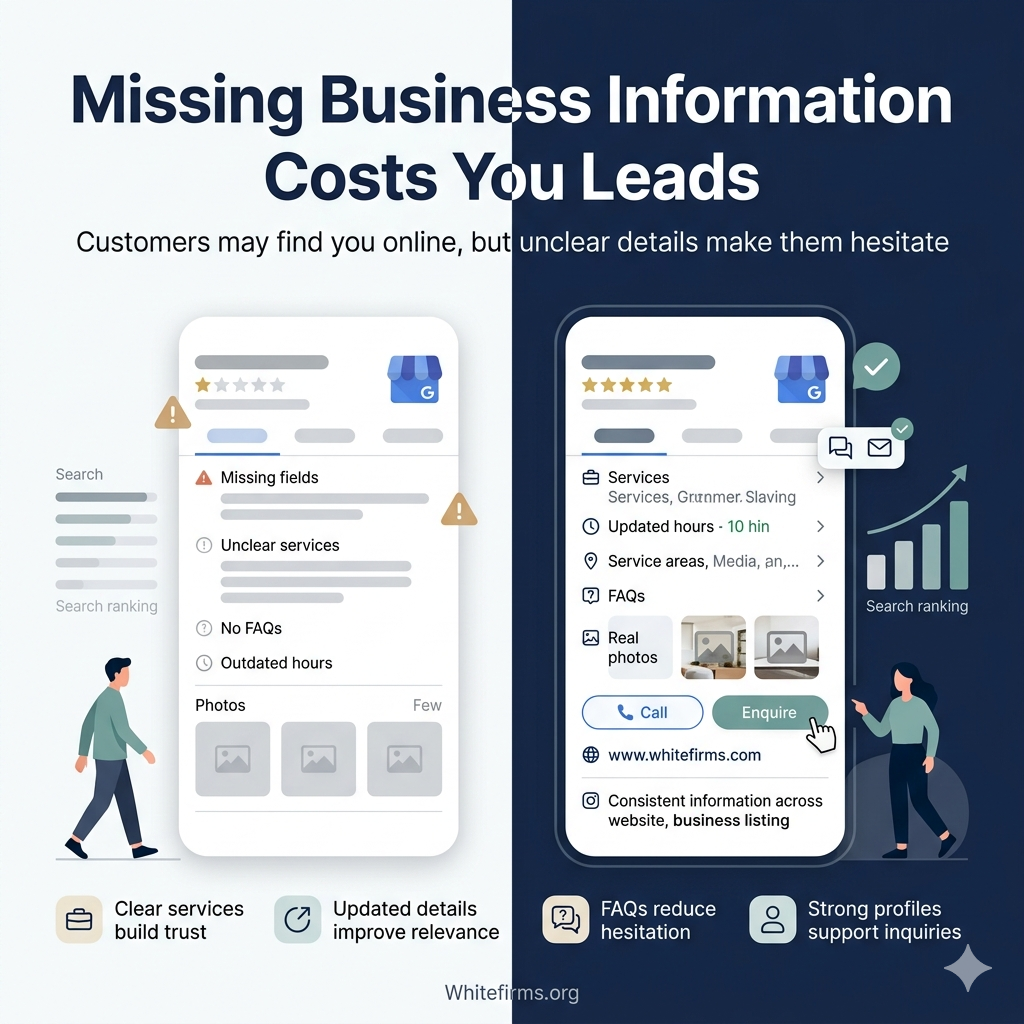
Missing business information lowers online trust, makes it harder to appear in relevant search results, and reduces the likelihood that visitors will become real customers. A customer may find the business, but if important details are unclear, inconsistent, or missing, they hesitate right away. Search engines also struggle to understand the business when online information is too limited, too general, or poorly organized across sites.
This is where many businesses lose leads without realizing it.
A business can be online and still look unconvincing.
Many local and service businesses have some online presence, but it lacks detail. Their Google Business Profile might only show a name, phone number, and a brief description. Their website may have a homepage and contact page, but little information about services. Their social media pages may be active, but mostly have greetings, general posts, or pictures without clearly explaining the business.
For example, imagine a plumbing business with a Google Business Profile that lists all main services like leak repairs, bathroom remodeling, and emergency help, with clear descriptions and current hours. Their website has separate pages for each service, explains prices and response times, and shows photos of recent work. Their social media posts share real project stories, answer common customer questions, and show photos that match the services. This detail helps customers quickly see whether the business fits their needs and makes a much stronger impression than basic info alone.
This is a serious problem.
People rarely contact a business just because it exists online. They contact a business when they understand what it does, who it serves, where it operates, and why it feels relevant to their needs. If that information is missing, people move on. In competitive categories, they move on very quickly.
Why missing business information reduces trust
Customers notice missing information right away.
When a business profile does not clearly explain its services, service area, process, working hours, experience, or main focus, customers end up guessing. They may wonder whether the business is active, whether it can meet their needs, whether it is trustworthy, or whether the owner cares enough to keep professional information online.
For service businesses, trust depends on complete information before first contact.
A dental clinic, for example, may have a Google Business Profile and some good reviews, but if the profile does not clearly mention treatments, the website does not explain procedures, and social media only posts festive creatives, a person searching for braces, root canal treatment, or cosmetic dental work may not feel enough confidence to enquire. The issue is not only visibility. The issue is an incomplete presentation.
The same applies to law firms, tax consultants, interior designers, wellness centers, and many other businesses. Missing details create doubt, and doubt reduces inquiries.
Why missing information affects rankings
Businesses often think rankings depend only on reviews, backlinks, or website age. Those matters, but so does relevance.
Search engines need clear information to understand what a business really does. A Google Business Profile with unclear categories, weak descriptions, few service details, and outdated info sends fewer signals. A website with very short service pages, missing location info, and no helpful content is also harder to rank. Social media pages may raise awareness, but if they do not make the business clear, they add little to search rankings.
Businesses face real ranking issues with vague information.
A coaching institute may want to appear in searches for NEET coaching, IIT foundation classes, or spoken English for job seekers. But if its website only says “best institute for quality education” and its Google Business Profile has almost no course details, search engines have a hard time linking the business to those searches.
A chartered accountant may want to attract clients for GST filing, start-up registration, audit help, or tax planning. But if the website only says “financial services” and the Google Business Profile does not clearly explain what those services entail, the firm seems too general.
Strong rankings require strong, clear business information.
Why website visitors often leave without enquiring
Many business owners say the same thing. They get some traffic, some impressions, even some profile views, but not enough leads.
Visibility exists, but clarity is missing.
A visitor comes to a profile or website with a question. They want to know if this business can meet their needs. If the answer is not clear quickly, they leave. Most people do not try hard to figure out an incomplete business profile.
For example, an interior design business may have an attractive Instagram page full of polished pictures of kitchens and living rooms. But if the Google Business Profile does not say if the business handles modular kitchens, full-home interiors, office spaces, or renovations, and if the website does not explain service areas, budget options, process, or project style, many potential clients will leave without asking. They may like the pictures, but still do not know if the service fits their needs.
This pattern repeats across industries. Businesses often lose leads not because people dislike them, but because they do not provide enough usable information.
Google Business Profile is often underused.
Local businesses expect Google Business Profile to generate calls on its own. But most profiles are incomplete, outdated, or too vague to convert interest into action.
Common issues include:
- missing service descriptions
- weak category relevance
- incomplete business details
- outdated hours
- very few useful photos
- no FAQs or supporting updates
- Inconsistent information compared to the website
- no clear explanation of specializations
A fitness center may post workout videos on Instagram, but its Google Business Profile might not say whether it offers women-only training, personal coaching, beginner help, weight-loss programs, or strength training. So even when people find the business, they do not get enough clear information to ask confidently. For bridal and designer wear inquiries, but if its Google Business Profile does not mention custom stitching, appointment-based visits, bridal consultation, blouse design, or delivery timelines, it misses people searching with practical buying intent.
Missing business information directly hurts both rankings and conversions.
Social media visibility does not replace business clarity.
Active social media does not fix the lead problem.
Posting regularly may help people see the business, but if social pages do not clearly explain what the business does, its main services, target customers, location, and proof of work, they only create shallow interest. Social media often sparks curiosity but does not always answer buyer questions.
A law firm may post legal updates, visa news, or business tips on LinkedIn and Instagram, but if its website and profiles do not clearly explain the exact cases it handles, how consultations work, or its main focus, visitors do not become clients. A visitor may like the info, but still not know if the firm fits their problem.
Businesses need more than content activity—they need full, clear, structured details across all platforms.
Realistic examples of businesses losing leads due to incomplete information
A coaching institute may offer classes for IIT foundation, NEET, and intermediate students, but if its online pages only say “best faculty” and “excellent results,” parents still do not know about class size, levels, test setup, or mentoring help. The institute may appear in searches but fail to receive inquiries.
A dental clinic may post before-and-after pictures, but if it does not clearly explain treatments, how appointments work, the consultation steps, or the doctor's specialties, many visitors will keep comparing with other clinics.
A CA firm may share helpful tax posts, but if its website does not clearly explain GST filing, company setup, audits, and compliance in clear, separate sections, the firm seems too general to rank well or attract many clients.
A salon or bridal studio may post attractive content on Instagram, but if clients cannot easily find details about bridal makeup, trial sessions, package options, appointment booking, or service areas, the profile may generate interest but not enough bookings.
AA wellness center may mention therapy, nutrition, yoga, and stress help, but if it is not clear who does what, whether sessions are online or in person, and which clients are served, visitors lose confidence.
In all these examples, the issue is not absence but under-explanation.
Checklist: What to include online
A powerful online presence means sharing the right information, not just more words.
Use this checklist to make sure your essential business information is easy to find and helps you convert interest into real leads:
Accurate business category relevance- updated contact details and timings- service area clarity- Practical FAQs
Visuals that support trust- Detailed website pages for core services- Matching information across Google Business Profile, website, and social pages- Proof of credibility through a useful business presentation
This gives both users and search engines more confidence in what the business actually offers.
Why a richer business profile can improve outcomes?
A complete business profile does more than inform. It reduces friction.
When people find useful and specific information, they spend less time guessing and more time deciding. They are more likely to call, message, visit, or enquire. Search engines also get stronger signals about what the business does and who it is relevant for. That is why richer business profiles often perform better than thinner ones, even when both businesses are in the same category. The better-presented business does not always win, even if it is better in reality. Sometimes it wins because it explains itself better online.
How White firms can help
White Firms is a business listing and digital visibility platform that helps companies improve their online presence. White firms can help businesses move beyond a thin online presence by creating a richer business profile that explains services more clearly, adds useful business content, includes visuals, answers practical customer questions, and strengthens how the business is understood online.
This is valuable because many businesses already have a Google Business Profile and a website, yet both still have limitations. A website alone may not easily attract strong backlinks, and a Google Business Profile is not something a business can safely push through aggressive backlink tactics. In fact, small errors in backlink building, especially poor-quality or irrelevant links, can do more harm than good, harming search visibility rather than improving it.
White firms help businesses overcome that difficulty by consistently building more relevant, higher-quality backlink support around listed business pages. It also supports ongoing social media post scheduling and broader content circulation, which can drive repeat visitors to the business profile, website, and Google Business Profile. These repeated discovery signals, when supported by a strong, complete business page, can contribute to better visibility over time and help the business appear more active, credible, and relevant within its market or region.
That makes White firms useful not only as a listing platform but as a support layer for stronger digital discoverability.
A missing detail can become a missed inquiry.
Businesses often focus on doing more marketing when the real need is a better presentation.
If your Google Business Profile is thin, your website is unclear, and your social pages do not explain enough, then visibility alone will not bring the right results. Missing business information weakens trust, reduces relevance, and causes lost opportunities at every stage of the buyer journey. Take the first step by reviewing your Google Business Profile today. Check for missing details, outdated information, or anything that might stop a potential customer from reaching out. A few improvements now can start making a difference right away.
That is why complete online information is not a small technical detail. It is part of how a business gets discovered, evaluated, and contacted.
A business that explains itself clearly stands a better chance of ranking well, building confidence, and turning attention into real inquiries.