




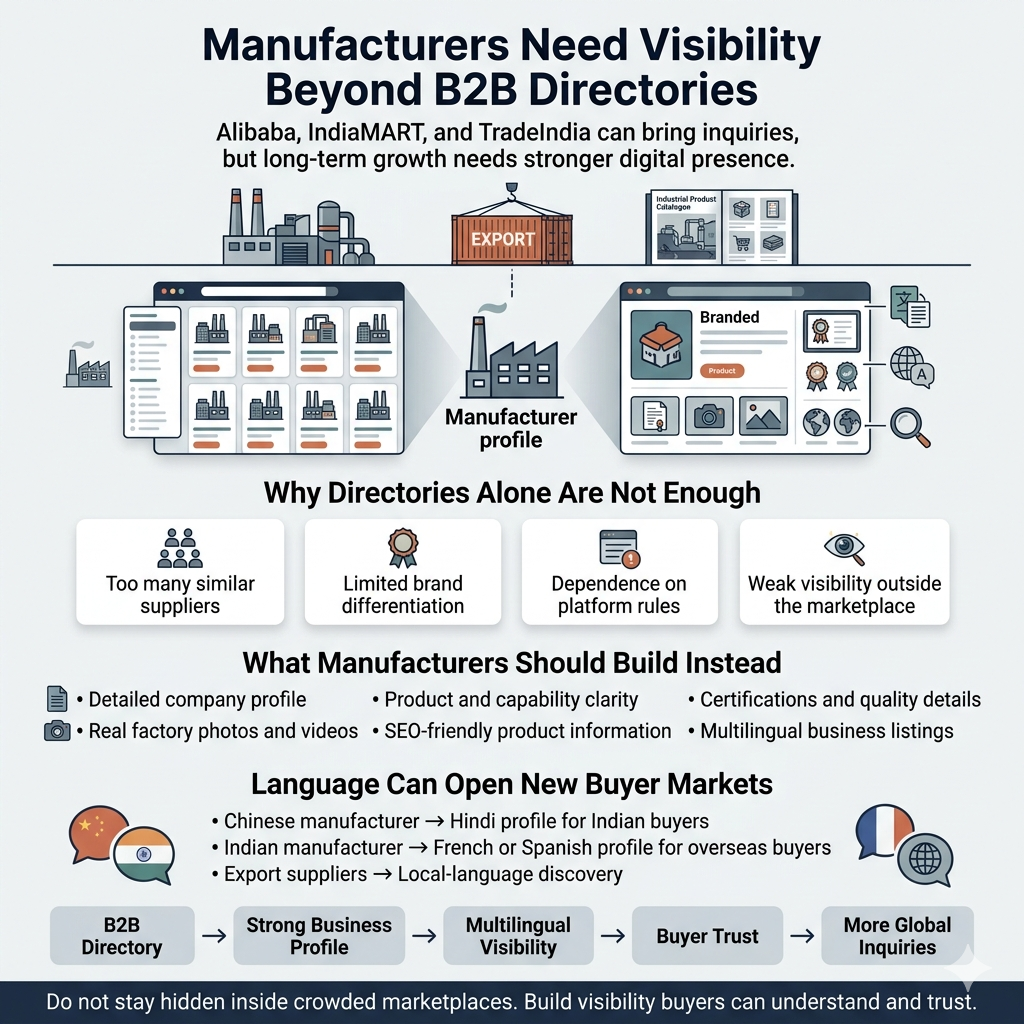
Why Manufacturers Need More Than Alibaba and B2B Directories to Grow Online
For manufacturers, relying solely on B2B directories often limits true online growth.
Platforms like Alibaba, IndiaMART, Trade India, and Made-in-China already attract buyers, importers, sourcing agents, and distributors. A manufacturer can register, upload products, add company details, and appear to potential business customers. For factory owners or export-oriented companies, this often feels like the most practical route because buyers are already there.
These platforms do serve a purpose. They help manufacturers get listed faster, become visible in a known marketplace, and connect with buyers who are actively searching. Many businesses have generated inquiries through them and, in some cases, continue to rely heavily on them.
But dependence on these directories alone creates a limitation that many manufacturers do not fully address. They may be visible on the platform, but not sufficiently visible to the business outside it. They may be listed, but not clearly understood. They may receive occasional inquiries, but still remain one among hundreds of similar suppliers competing on the same screens.
This brings us to an important consideration: what else should manufacturers do to address this gap and drive real growth online? In the following sections, we will explore practical steps and specific actions manufacturers can take to strengthen their online presence, overcome the limitations of directories, and stand out in global markets. These concrete recommendations can help guide manufacturers toward more effective digital growth.
B2B directories help visibility, but they also create dependence
A manufacturer of machinery parts, textiles, packaging, metals, chemicals, electronics, furniture, or industrial consumables may have a profile on B2B portals. The issue is not platform ineffectiveness, but manufacturers stopping there.
Once listed on a major B2B marketplace, many businesses assume they have handled their online presence. In reality, they have only entered a larger supplier pool where buyers compare dozens of options at once.
A company profile in a directory is often shaped by that platform's format. Product titles, company summaries, specifications, certifications, and response features are usually standardized. While that helps comparison, it also makes it harder for an individual manufacturer to present depth, distinct identity, production approach, or market relevance in a fuller way.
This is especially true when buyers are comparing many suppliers offering near-identical products. In such cases, a factory may have stronger production capabilities, better customization, more stable export processes, or a better understanding of the market, but the differences are not always clearly visible in a crowded marketplace.
That is why manufacturers need more than a listing on Alibaba or similar directories to achieve long-term digital growth.
Beyond the limitations of directories, another growth challenge comes into focus: the underuse of SEO, content, and social visibility by many manufacturers.
A common pattern in the manufacturing sector is this: strong factory capability, weak digital storytelling.
Many manufacturers invest heavily in production and logistics but rely almost entirely on trade platforms and direct outreach for digital presence.
Few consistently invest in stronger online identities through SEO, multilingual discoverability, content, or social media that reflect their strengths.
Some do have websites, but those websites are often minimal. They may include a homepage, a product page, and a contact form, but offer little clarity on production capacity, export markets, customization ability, service areas, or industry-specific strengths. Others have no meaningful visibility beyond their B2B portal profile.
This matters because industrial buying is no longer confined to a single platform. Buyers search in multiple ways. They compare suppliers, assess business credibility, review capabilities, check categories, search in their own language, and often seek to understand a manufacturer before initiating contact.
If a manufacturer is visible only inside a directory ecosystem, it is giving up control over how its business is discovered and understood elsewhere.
The issue is not only visibility. It is also a differentiation.
Most manufacturers struggle not because of their capabilities but because their online presence fails to adequately showcase their strengths.
A Chinese industrial fastener manufacturer may appear among thousands of similar suppliers on Alibaba. An Indian packaging film manufacturer may be on IndiaMART, among many peers. A textile unit with export capacity and custom dyeing may still seem like an ordinary supplier online.
Often, production is not the issue—clear digital positioning is.
A manufacturer profile should help answer practical questions from buyers. What kind of production does the company handle? Which industries does it serve? Does it support custom orders? Does it cater to domestic buyers, exporters, wholesalers, or institutional clients? Which regions is it trying to reach? What makes its operations credible?
Manufacturers should ensure they address buyer concerns directly in their listing profiles by providing clear, detailed answers to common questions. Businesses should highlight their unique value propositions and core strengths to build trust and stand out from competitors. For example, a manufacturer might emphasize quick turnaround on custom orders, in-house design and engineering teams, advanced quality certifications, experience serving major global brands, specialty production capabilities, sustainable material sourcing, or reliable after-sales support. By spelling out specific strengths such as "ISO-certified processes for strict quality control" or "customizable batch sizes for small and large orders," manufacturers help buyers visualize their differentiated value. Doing so helps buyers make informed decisions and strengthens the manufacturer’s online presence.
Having clarified the need for clearer positioning, let’s turn to another powerful yet overlooked lever: language.
One major gap in manufacturing visibility is the language used.
Most manufacturers present themselves only in English, even though their target markets may search, compare, or interact with suppliers more comfortably in another language. This becomes a missed opportunity, especially in cross-border trade.
Take a realistic example. A Chinese manufacturer may already be listed on Alibaba in English, but if it wants to attract Indian distributors, wholesalers, or sourcing businesses, a Hindi-language listing can make it more approachable during the early research stage. It signals effort, market intent, and audience understanding.
Now look at the reverse. An Indian manufacturer may already be listed on TradeIndia or IndiaMART, but if it wants to expand its international reach, a business profile in French or Spanish can help make the company more visible and easier for buyers in language-driven markets to understand. This does not replace export platforms, but it does expand the business’s ability to be discovered beyond one standard channel.
Manufacturers should prioritize language strategy. They must identify and use relevant local languages in market-specific listings to build trust, improve accessibility, and increase their relevance in target regions. Proactively adding multilingual content expands market reach and supports international growth. There are practical ways to create multilingual content, such as using professional translation services, hiring freelance translators for specific languages, or leveraging local language experts who are industry-savvy. Simple translation tools can help get you started quickly, but for better accuracy and cultural relevance, it's recommended to seek professional help. By approaching language systematically and practically, manufacturers can make their business more approachable and visible to wider audiences.
Why manufacturers need an additional visibility layer
- Manufacturers should not abandon Alibaba or other B2B directories. These platforms still matter. They have reach, buyer traffic, and market familiarity.
- But relying only on them is risky for several reasons.
- First, the manufacturer remains dependent on third-party ecosystem rules.
- Second, the business gets positioned next to countless similar suppliers.
- Third, differentiation becomes harder.
- Fourth, the company misses the chance to build visibility in market-specific languages.
- Fifth, it limits discovery outside the directory.
Manufacturers should proactively add an additional online layer that shares their company story, capabilities, and unique offerings in greater depth and across multiple languages. This improved visibility layer reinforces market targeting and helps them take control of their digital reputation outside basic directories.
At this stage, a fresh approach can help bridge limitations. This is where a platform like White Firms can offer manufacturers a different layer of visibility.
How White firms offer a different kind of visibility
White firms are useful because they allow manufacturers to build a more comprehensive business listing that is not confined to the rigid comparison format of major B2B marketplaces.
Instead of functioning only as another name in a supplier database, a manufacturer can use White firms to present its business with more substance. The listing can communicate what the company does, the categories it serves, the market it aims to reach, and how its business should be understood by a specific audience.
More importantly, White firms create multilingual opportunities that can support real market targeting.
A Chinese manufacturer can create a business listing in Hindi to make itself more approachable to Indian buyers. This is a practical move when targeting a growing market where local-language clarity can influence early trust. An Indian manufacturer can build a profile in French or Spanish to improve discoverability among overseas buyers who may prefer researching suppliers in their preferred language before sending an inquiry.
This approach does not replace websites or export portals, but it strengthens the digital presence by adding a discovery route.
White firms also help listed business pages gain visibility through structured, content-rich business presentations. That matters because a listing page cannot rank or attract attention merely by existing. It needs meaningful information, category relevance, and proper presentation so that both users and search engines can make sense of it. To create an effective business profile, manufacturers should ensure their listing includes key content elements such as certifications, client case studies, detailed production capacity, export experience, industry awards, specialized machinery or processes, quality control measures, photos and videos of products or facilities, key personnel or team introductions, and clear contact information. Highlighting these elements strengthens the credibility, depth, and distinctiveness of the manufacturer’s listing, improving its appeal to potential buyers.
For manufacturers, this means the listing is not treated as a thin directory entry. It becomes a more detailed business profile designed to support discoverability and better understanding.
A more realistic growth approach for manufacturers
Manufacturers often think in practical terms. They want channels that drive inquiries. That is why B2B portals remain attractive. But long-term digital growth requires more than staying inside large supplier marketplaces.
A stronger approach is to combine channels.
Manufacturers should strategically use major B2B platforms for initial discovery while also building a broader presence through robust company profiles, multilingual business listings, strong SEO, and clear, detailed digital presentations. For those just starting with SEO, some basic steps can help: conduct keyword research to find out what potential buyers are searching for, use those keywords thoughtfully in product titles and descriptions, write clear meta descriptions, optimize images with relevant file names and alt text, and create distinct pages for key products or services. Even small actions, such as keeping product information up to date and making sure contact details are accurate and easy to find, can improve search visibility. Expanding efforts in these areas will better communicate their capabilities and differentiate them from competitors.
That combination helps reduce overreliance on a single source. Take steps now to expand your online presence, diversify visibility, and drive long-term business growth.
For example, a valve manufacturer in China targeting Indian industrial buyers should not rely only on English-language listings inside export portals. A Hindi-facing business profile can make the company more understandable to the target market. Similarly, an Indian manufacturer of garments, food-processing equipment, or packaging products seeking overseas inquiries can benefit from a French or Spanish business profile that presents the company more naturally in those markets.
These are not exaggerated ideas. They are realistic extensions of how manufacturers can widen digital visibility.
Growth online should not stop at directory registration.
A manufacturer may begin with a B2B directory. That is reasonable. But it should not end there.
The real opportunity lies in building a presence that gives the business greater control over how it is presented, how it is discovered, and which markets it can reach more directly. In a sector where many suppliers still look similar online, better presentation and multilingual discoverability can become a meaningful advantage.
Alibaba and other directories can open one door. But manufacturers that want broader digital growth need more than one door.
They need visibility beyond the marketplace, stronger control over how their business is presented, and better ways to reach buyers across languages and regions.
That is exactly why manufacturers need more than Alibaba and B2B directories to grow online.