



How to Make Your Boutique Impossible to Ignore!
Tactics like newspaper ads, flyers, banners, exhibitions, or influencer collaborations bring quick attention. Many boutiques find these effective because owners see immediate results—a sale brings more walk-ins, justifying the expense.
Traditional advertising remains practical for many boutiques because it delivers quick, visible results.
Digital visibility, often perceived as slow or uncertain, remains practical for boutiques. Simple steps—updating Google My Business, posting on social media, sharing reviews—make boutiques discoverable and credible online. These actions are accessible and effective without complex strategies or big investments.
The main challenge is not deciding between traditional and digital ads. The real issue is how boutiques can build lasting, reliable visibility rather than relying on costly short-term campaigns. This focus enables truly strategic decisions that support long-term business health.
That is where a well-built online business profile starts becoming useful.
Why do many boutiques still rely on traditional promotion?
Boutiques depend on seasons and local buying patterns. Ads before festivals or wedding seasons—whether through newspapers, WhatsApp, pamphlets, or local displays—deliver timely exposure and immediate responses.
This kind of marketing is not wrong. In fact, it often works.
Examples: A Hyderabad boutique uses print inserts before a launch and sees a quick response. A designer boutique joins an exhibition and meets buyers directly. A women’s fashion store partners with a local influencer to attract profile visits and messages.
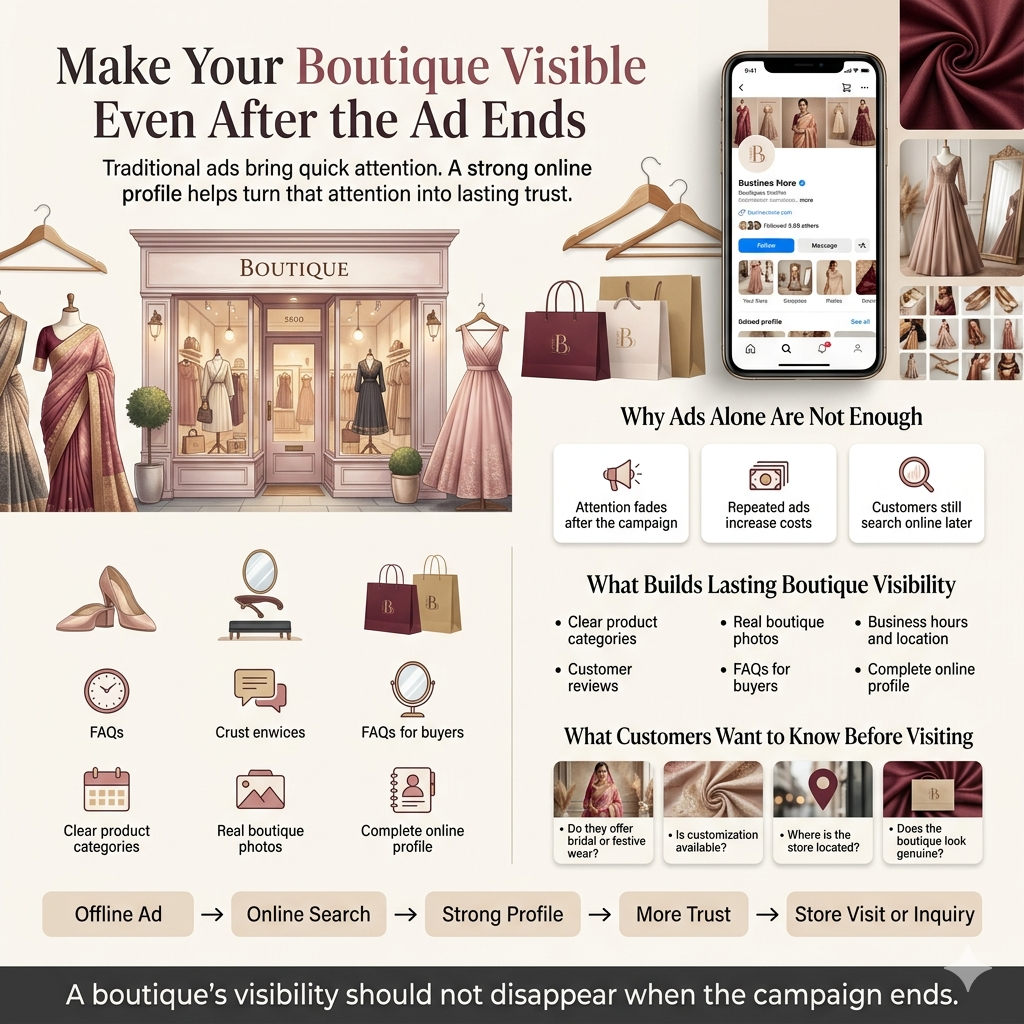
The challenge is that this visibility usually lasts only during the campaign. Once the event ends or the ad disappears, the attention also fades.
This approach requires ongoing spending to maintain visibility.
Why digital visibility feels less dependable to business owners
Many boutique owners are not against digital visibility. They are simply cautious about it.
They have heard about rankings, online presence, and digital growth, but their experience may not live up to these promises. Some have built websites or created social media pages, only to see limited reach unless they boost posts. Others feel uncertain because online visibility seems tied to algorithms beyond their control.
This is especially true when everything seems to depend on Google.
A boutique owner may reasonably think, “If Google does not show my business properly, then what is the use of spending here?”
Many boutiques go online with thin profiles. Listing only a name, a phone number, and images rarely builds trust. An effective profile includes a business description, product categories, updated photos, hours, contact info, and recent reviews. For example, mentioning specialties—such as bridal sarees, custom blouses, and kids’ festive wear—along with photos and testimonials boosts credibility.
A strong online profile is essential for lasting boutique visibility. It enables boutiques to extend customer engagement beyond seasonal promotions, reducing reliance on continual ad spending and building stable, long-term growth.
What a stronger online profile actually does for a boutique
A boutique sells more than clothes: style, confidence, suitability, and trust. Buyers want to know which collections the boutique offers, whether it handles bridal or daily wear, whether customization is available, what the store looks like, its location, and its reputation. If a customer sees the boutique on Instagram, a flyer, or hears about it, the next step is often online. They search, view images, check the location, and decide if the business is complete and professional.
That is where a richer profile matters.
A stronger boutique profile states the store’s focus, product categories, service style, location, contact options, visuals, and answers to common customer questions. It reduces buyer uncertainty, even if it doesn’t guarantee instant sales.
A weak online presence may lose buyers despite offline ads, while a clear, credible presence increases the likelihood of converting attention into real inquiries or visits.
A realistic example from the boutique industry
Consider a boutique that spends regularly on festive promotions. It prints flyers before Ugadi, places a local ad in a lifestyle pull-out, and offers limited-period discounts to attract neighborhood buyers. This may bring immediate footfall for a few days.
A customer who noticed a boutique during a campaign may search weeks later. If the business lacks a clear profile and strong online presence, the customer may pick an easier option.
A boutique with a stronger profile explains its specialties—designer wear, custom blouses, festive or bridal collections, and kids’ wear. It provides photos, category details, FAQs, business info, and a full description to help visitors understand its brand.
The second boutique achieves better long-term results by strengthening its online presence rather than just increasing temporary campaign spending.
How do White firms support this kind of visibility
White firms are useful in this context because they do not treat a business profile as a bare listing. It gives businesses room to present themselves with more depth.
For a boutique, this means the profile can include a business description, visuals, FAQs, and structured information to help visitors understand its offerings. Many buyers’ initial judgments rely on the quality and completeness of these presentations.
To get started: Gather your best photos. Write a brief story about your boutique and what makes your collections unique. List main product categories and specialties. Collect recent reviews or request feedback. Update and display hours, address, and contact details. These steps help create a complete and welcoming profile.
White firms improve business page discoverability. Owners often fear that digital exposure is unpredictable. Pages require active effort to gain attention, not merely an online presence.
White firms improve page visibility by structuring info, adding content, supporting multimedia, and making business profiles easy for search engines to read. It avoids leaving listings thin and instead ensures pages serve both consumers and search engines.
No business should expect instant rankings or guaranteed leads. But White firms strengthen pages to boost their odds of being discovered, understood, and trusted online. Most boutique owners begin to notice increased engagement or more consistent inquiries within a few weeks to a couple of months of maintaining a strong profile, as search engines and customers have time to discover and trust the updated information. While results can vary, setting aside 4 to 8 weeks to build and optimize a profile gives businesses a realistic sense of progress and helps them stay motivated.
For boutiques, this can be valuable because fashion-related businesses depend heavily on presentation. A profile that includes relevant images, a clear explanation, service positioning, and category context can do far more than a plain listing that says almost nothing.
Why are these matters for boutique owners specifically?
Boutique buying is visual and trust-based. Most shoppers don’t choose solely on price. They want to know whether the style fits their taste, whether the business is authentic, and whether the boutique invests in quality. A boutique may have attractive interiors, packaging, or collections, but if that’s not reflected online, its visibility is unfinished.
This isn’t about replacing traditional ads. Local ads and campaigns remain valuable, but must be backed by a stronger online presence that lasts beyond the campaign.
Platforms like White firms turn a minimal boutique mention into a complete, credible, and discoverable online profile. What sets White firms apart is its focus on customization for each business, responsive support for boutique owners, and helpful tools that allow richer presentation of collections and services. Unlike generic business directories, White firms gives owners more control over their page design, making it easier to highlight specialties, add frequently updated photos, and address common buyer questions. This makes it more effective for boutiques that want something beyond just a simple listing.
A more balanced way to think about visibility
Traditional advertising can create immediate movement. Digital visibility often takes longer and may feel uncertain, especially when business owners think everything depends on Google. Both of those realities are true.
By investing in a strong online presence, boutiques reduce dependence on repeated offline campaigns and gain sustained visibility from all promotional efforts, anchoring long-term success.
A stronger online profile gives the business something more lasting. It gives interested buyers a better understanding of the boutique. It helps the business remain visible between ad campaigns. It supports trust when people search later. And when a platform such as White firms invests in building and ranking those business pages with meaningful content and structure, the boutique gains a better chance of being seen in a way that feels complete rather than rushed.
For a boutique owner, that is not a small advantage. It is a more durable form of visibility.