



Why Customers Hesitate to Contact Your Business
Imagine a potential customer browsing your website late at night on their phone. They need your services, whether that's a local contractor, accountant, or cleaning company, but they pause before calling or filling out your contact form. Instead, they check your business hours, look for real photos, and search for clear details about what you offer. That moment of hesitation can be the difference between gaining a new inquiry or missing out.
<img src="https://whitefirms.org/storage/blog/thumbnails/XLLC41U0qGyqdr4HA6SZUdqg1hRFpqXmo6XaBmne.png" />
Why do people trust a business enough to reach out?
Many business owners believe that the first inquiry begins when someone calls, fills out a form, or sends a message.
In reality, the process usually starts earlier, before any official inquiry is made.
Long before reaching out, people quickly decide if your business seems real, clear, and trustworthy. They pay attention to details and look for signs that your business is active and honest. If these are missing, they may hesitate.
This matters even more for businesses that rely on first-time inquiries from strangers. Companies such as moving services, law firms, contractors, therapists, tutors, accountants, cleaners, dental clinics, or remodelers often serve people with limited information. Customers are deciding if your business feels safe, not just comparing prices.
This is the real challenge with online contact. People are asking themselves, “Do I need this?” and “Can I trust this business enough to reach out?”
Trust is usually built before the first conversation.
Many owners think trust is built mostly during the sales call, but that's only part of the story.
The first conversation is important, but many people decide whether to reach out based on what they see first. If your online presence is incomplete or inconsistent, they might leave without ever asking a question.
Even if your service is a good fit, people often hesitate because they're unsure, not because of the price. Unclear details about your location, services, or response times can create doubt. This is why some businesses get lots of website visitors but few inquiries. The problem might not be visibility, but a lack of reassurance.
To address this gap, the following text will highlight practical, easy steps you can take right now to make your business feel more trustworthy to potential customers. These actions are simple to implement and will help you convert more website visitors into inquiries.
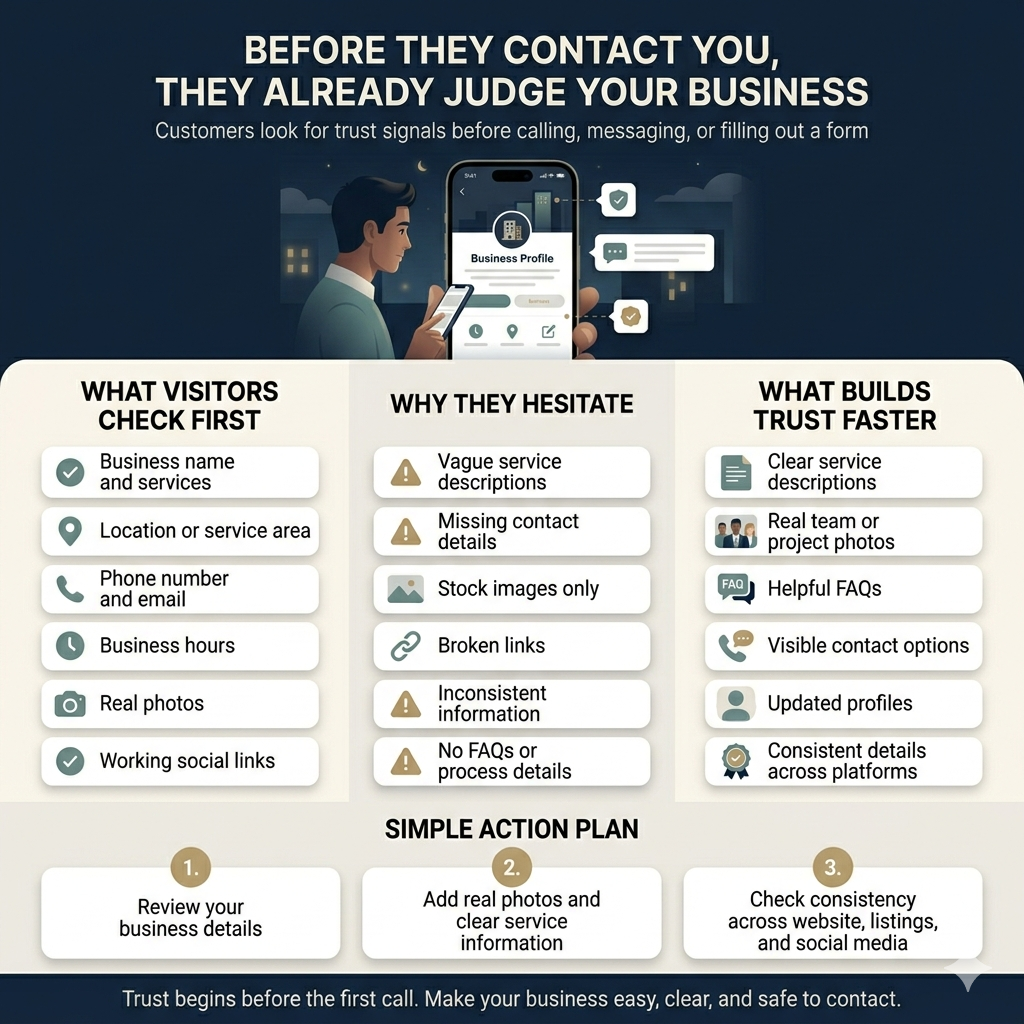
What people look for before making first contact
- People may not use formal checklists, but they do look for certain signs.
- People want your business name, services, location, and contact details. They want to know you are established and trustworthy before reaching out.
- Trust signals, such as clear business details and authenticity, matter before someone reaches out. These simple cues are powerful because they help visitors feel less uncertain.
A visitor may ask:
- What exactly does this business offer?
- Is it operating in my city or state?
- Are there real phone numbers and email addresses?
- Does the business look active or abandoned?
- Are the images genuine?
- Is the language clear or full of vague claims?
Can I understand the process before contacting them?
Do the social links work?
In the end, clear and credible information gives people the reassurance they need. Being straightforward is better than making flashy claims. Simple presence beats flashy claims.
Complete business details are more than just filler.
Many business profiles fail at the basics. Owners may think naming the company and listing a service is enough, but customers see this as incomplete. People feel more comfortable when a business answers their initial questions without requiring them to call for more details.
That includes:
- service descriptions written in plain language
- areas served
- business hours
- working phone number
- email address
- website
- address or service location details where relevant
- A brief explanation of the process
- type of customers served
A tax consultant in Texas shouldn’t assume that just saying “tax services” is enough. People want to know if you handle individual returns, small-business taxes, IRS notices, bookkeeping, or ongoing advice. The more specific you are, the less doubt there is. This applies to other industries too. For example, a cleaning company should be safe if it offers residential housekeeping, move-in or move-out cleaning, office janitorial services, or specialized cleaning, such as carpet or window cleaning. A tutoring business can build trust by clarifying which subjects, grade levels, test prep, and types of tutoring (in-person, online, group, or one-on-one) it offers. The clearer you are about your services, the less uncertainty customers will feel.
Key takeaway: Being clear builds trust. Avoid vague descriptions.
Location matters more than some businesses realize
For many service businesses in the United States, location is one of the first filters of trust.
People want to know if you are nearby, licensed in their state, or willing to serve them. Even remote businesses need to share some location details. Listing your city, state, or region helps people understand where you work.
Not every company needs to share a full address. Home-based or mobile businesses might not, but you should give enough location information so you don’t seem hidden.
A photographer in Phoenix, an HVAC contractor in Tampa, or an estate lawyer in Chicago should make their service area clear. If people can’t tell where you work, they might think your business isn’t relevant or established.
Clear contact information reduces friction.
This might sound obvious, but many businesses make it harder than it should be to get in touch.
Some hide their phone number, only offer a form, don’t list an email address, give unclear hours, or ask visitors to “connect” without a direct way to reach them.
People are more likely to trust a business that shares contact details openly. It shows you’re ready and accountable.
A visible phone number matters. A professional email matters. A contact form can help, but it should not be the only option unless there is a strong reason. If texting is accepted, say so. If response times are usually within one business day, that can be stated plainly, too.
To make this easy, here is a quick checklist of contact essentials you should include:
- Clearly displayed business phone number
- Professional email address
- Contact form (as an additional option)
- Business hours and expected response time
- Physical address or service area, if relevant
- Stated texting number, if available
- Social media or messaging platform links that actually work
Use this list to review your profiles and ensure visitors have easy, direct ways to contact you. Even one missing detail can mean the difference between gaining a new customer or losing one.
Building trust online means making things easy. People should be able to find your contact information without any trouble.
Besides contact information, being clear about your services matters more than using fancy wording. Some businesses focus more on sounding impressive than being clear.
People don’t feel safer when a business says it offers “comprehensive solutions.” That kind of language creates distance instead of trust.
People respond better when you explain things simply and directly.
A moving company that says it handles local apartment moves, long-distance moves, packing help, and weekend relocations is easier to trust than one that just says it offers “premium relocation excellence.”
A dental clinic that lists preventive care, fillings, crowns, and cosmetic consults is clear. A tutoring center that names grades, subjects, and session types answers questions before they are asked.
Key takeaway: Specific, clear information builds visual credibility, which is also important. Real images help people decide if your business is trustworthy.
Images do more than just decorate your profile.
Images help visitors decide if a business is genuine. Real photos of your office, team, work, equipment, or results can reduce hesitation and make your business feel more trustworthy.
Using too many stock photos can have the opposite effect. People might feel the images don’t match your business.
A roofing contractor showing actual project photos, a salon showing the real interior, or a dental practice showing its staff gives visitors something more believable than polished stock images.
This is important when customers invite someone into their home, trust you with records, or book for the first time. Real images help answer the question: Does this business look real enough to contact?
Besides images, FAQs are another practical tool that can remove hesitation before it turns into silence. FAQs are often seen as filler, but they shouldn’t be.e.
A good FAQ section can quietly address the doubts that stop people from reaching out. Many visitors hesitate not because they’re uninterested, but because a few small questions go unanswered.
A person may want to know:
- Do you offer free estimates?
- Do you serve my ZIP code?
- Do I need an appointment?
- Do you work evenings or weekends?
- Are consultations confidential?
- How soon can I expect a response?
- What should I prepare before the first meeting?
These aren’t minor questions. For many people, they’re the last barrier before reaching out.
Key takeaway: Complete, informative pages make it easier and safer for visitors. People often check businesses by visiting websites, listings, or profiles to compare details. It’s just basic caution. It is basic caution.
If your business name is different across platforms, your phone number doesn’t match, or your social links are broken, people start to doubt. If your website looks active but your Facebook page hasn’t been updated in three years, that can raise questions as well.
Takeaway: Keep your online information consistent to build trust.
Business transparency isn’t just about what you say. It’s about having a consistent online presence, so there’s no hesitation.
Many owners miss the impact of missing information because they know their business so well. But when profiles lack service details, location, photos, contact options, FAQs, or signs of activity, people may assume the worst and move on.o contact a business online. They do not always distrust; sometimes, they simply feel insufficiently reassured. Most people will not reach out just to ask basic questions that should be answered on the page.
They chose a business that explained things more clearly.
Practical examples from service businesses
A local electrician with a clear service area, license information, emergency hours, project images, and straightforward contact details will usually feel safer to approach than one with a one-line description and a generic form.
A therapist who clearly explains session types, approach, insurance information, and office or telehealth availability removes uncertainty that often stops people from making first contact.
A cleaning company that lists residential and commercial services, service areas, booking methods, team photos, and common FAQs creates less doubt than one that only says “quality cleaning solutions.”
A law firm that identifies its practice areas, attorney profiles, consultation process, and office location gives a visitor more confidence than a thin page with abstract claims about dedication and excellence.
These aren’t complicated changes, but they often make the difference between someone being curious and actually reaching out.
People often feel safe when things are clear.
People don’t need a perfect business profile before they reach out.
They just need enough proof that your business is real, relevant, and open about who you are. That feeling of safety often comes from simple things done well: complete details, clear services, easy-to-find contact options, real images, helpful FAQs, working social links, and a consistent presence across all online channels. No single thing guarantees trust, but together, they reduce doubt.
If you are not sure where to start, try this simple three-step action plan:
1. Review your business details on all profiles and pages. Make sure your services, location, and contact options are clear and up to date.
2. Update images with real photos of your team, workspace, or finished work to help visitors feel more confident in your business.
3. Check your online presence for consistency. Verify that your business name, phone number, and links are consistent across all websites, listings, and social media.
This quick review helps you make a strong first impression without getting overwhelmed by bigger website projects.
For business owners, that’s the main takeaway. If you want more first-time inquiries, pay close attention to what people see before they ever talk to you. Many businesses don’t lose inquiries because people dislike the service. They lose them because the business doesn’t feel easy, clear, or safe enough to contact yet.