




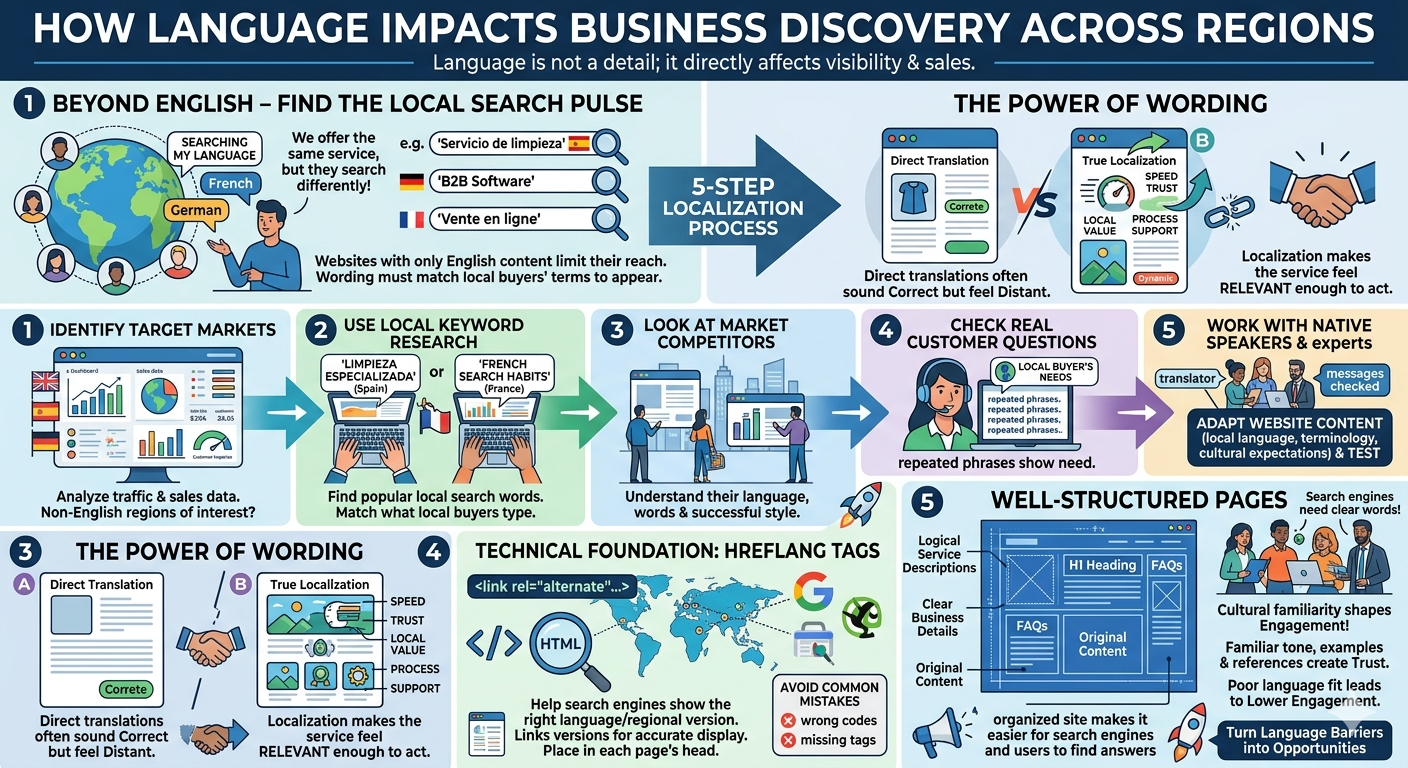
How Language Impacts Business Discovery Across Regions
Even with great service and presentation, finding a business online is hard if the website's language does not match local search terms. For example, a cleaning service in Spain got more visibility and inquiries by adding specific Spanish keywords to its website. Similarly, a B2B software provider in Germany improved lead generation by translating its technical documents and landing pages into German and using industry-specific words. An online retailer in France also increased sales by adapting content to match French search habits. While many focus on backlinks or design, language directly affects discovery. Use search-friendly language and organize multilingual content as Google suggests to make it easier to find.
People usually start searching in their own language. Even in places where English is common for business, many still search, compare, and decide in the language they know best. Google says that in many countries, users search in more than one language, and its systems find the most relevant results. Language is not just a small detail; it directly affects how easily a business can be found in different markets. Sites with only English content often limit their reach. It’s not just about language preference: if the wording doesn’t match local buyers' language, the page may not appear in their search. Businesses compete not just with other providers, but with various ways of describing the same problem.
To address this, it helps to follow a clear localization process:
1. Identify your target markets by analyzing website traffic, customer inquiries, or sales data to see where there is interest from non-English-speaking regions.
2. Use keyword research tools to find the most popular local search words your audience uses. This makes sure your website matches what local buyers type into search engines.
3. Look at competitor websites in the target market to understand the language, words, and style others use successfully.
4. Check real customer questions and support messages for repeated phrases or requests that show local buyers' needs.
5. Work 5. Work with native speakers or local experts to check your messages for relevance and natural wording. ate website content to reflect the local language, terminology, and cultural expectations, and test the pages with people from your target region when possible.
These steps quickly show which words and messages matter most in each region and help make website content easier to find.
Wording also changes meaning. Two pages can explain the same service and still give very different impressions depending on how the offer is presented. A direct translation may preserve the basic message, but it often misses how buyers in a given region think about speed, process, scope, trust, support, or value. A page can sound correct but still feel distant. This is one of the main reasons businesses struggle to turn international visitors into serious inquiries. The problem is not always demand. Often, the wording does not make the service feel relevant enough to act.
Multilingual content, when aligned with local search habits, gives people more opportunities to find your business. Google’s SEO advice is to use the words real users type when searching. This is even more important across languages because habits and expectations differ. Work with native speakers to make sure your content sounds natural and relevant. Use freelance sites, local agencies, or industry groups to find language experts. Test your content with local contacts. True localization goes beyond translation and fits how your audience really thinks and searches. Google also suggests using different URLs for each language version, rather than relying on cookies or browser settings, so search engines and users can easily find each page.
Hreflang tags are simple pieces of code you add to a website’s HTML. They help search engines know which language or regional audience each webpage is meant for. If your site has pages in multiple languages, hreflang tags connect the versions. This way, search engines like Google can show people the version in the right language for their country. Without hreflang tags, users might see a page in the wrong language when searching, or some versions may not appear as planned. Google does not read these tags to determine the content’s language; instead, hreflang tells Google which page to show to which users. Both correct language use and technical setup with hreflang tags help people find your business online.
To add hreflang tags correctly, place them in the head section of each language page, specifying both the language code and the regional version when needed. Make sure every language version links back to all others, including itself. Common mistakes to avoid are using the wrong language or country codes, missing matching tags, or linking all tags only to the homepage. Tools like Google Search Console, Screaming Frog, or special hreflang generators can help automate and check your setup. Regularly check your hreflang tags to catch errors early and ensure your international pages are shown to the right audience.
How you organize your page also matters. A well-structured page helps both search engines and users find what they need. Clear service descriptions, logical sections, original content, and consistent business details all make your site more relevant. This is especially important for companies working in more than one language. Search engines need clear words on the page to understand what your business does and who it serves.
Cultural familiarity shapes engagement. A page can be accurate but may not connect if the tone, examples, or references feel unfamiliar. Buyers respond better when services fit their situation. When content feels familiar, people spend more time on your site and are more likely to trust you. Even with a polished site, a poor language fit can lead to lower engagement, with users leaving quickly or hesitating to ask questions. Often, the problem is not service quality, but how language is used.
Regularly review your data, make changes, and turn language barriers into new business opportunities.