



Why Few Businesses Stay Invisible Even After Creating a Website
Many business owners assume launching a website means their digital presence is complete. However, soon after launch, they noticed a lack of inquiries, low visibility, and their business remained hard to find online.
The core question: Why does your business remain invisible online despite having a website?
A website is just one part of online visibility. Search engines and users seek full context: accurate details, relevant content, local focus, trust signals, and clear descriptions of what the business offers and whom it serves.
To boost visibility, start by updating or claiming your Google Business Profile if you haven't already. This is often the most impactful first step because it helps your business appear in local search results and maps, where many customers begin their search. Next, make sure your business information is correct and consistent across all online platforms: specify service areas, add helpful content or FAQs, share photos, and ensure contact details and hours are clearly displayed. Keep directories current. Prioritizing Google Business Profile first, then moving on to other directories, will help both people and search engines understand your business.
- A website can exist without being easily discovered.
- A website alone does not create visibility. Real online success requires more than just being present.
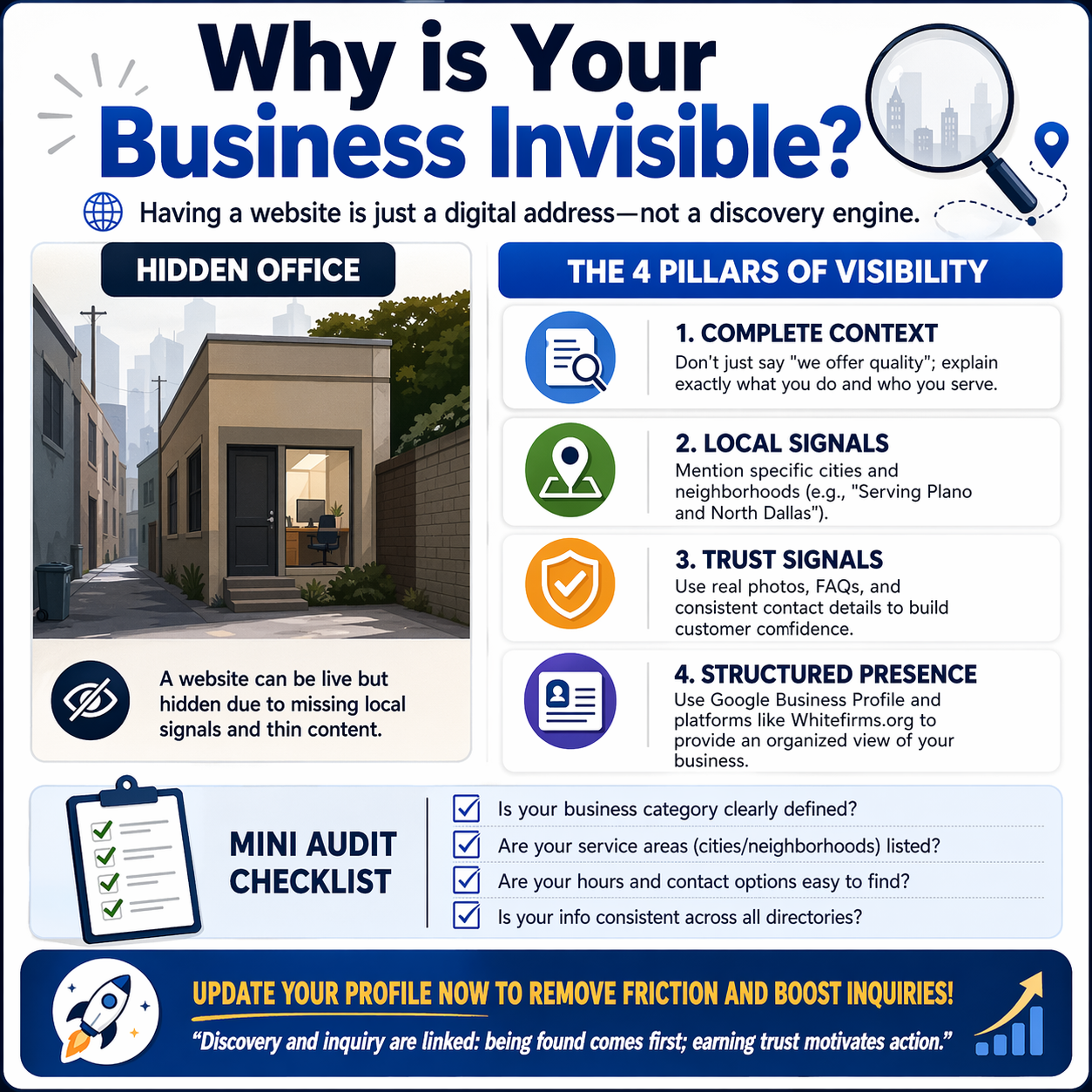
- Expectations falter because a website is just a digital address—not a discovery engine.
- If someone searches for your business name on Google, your site might appear. That is different from being found by people searching for your services in your area. A website can be live yet remain hidden due to low relevance, missing details, poor local signals, thin content, or an absence of external presence.
- Think of it this way: Opening an office in a quiet lane with no sign, no directions, no local references, and no word-of-mouth won't bring steady visitors. A website can face the same issue online.
- The main reason people ask, “Why can’t my business be found online?” is incomplete or inaccurate business information.
- This problem leads to a second major challenge: poor business information makes discovery harder.
A common issue is incomplete or weak business information.
Websites often make broad claims, stating what the company does but not where it operates, who it serves, or how to contact. Essential details like phone number, address, hours, service locations, or business category may be missing or hard to find.
- Quick self-audit checklist: Must-have business details
- Business name
- Phone number and email
- Complete business address or service areas
- Specific services offered
- Operating hours
- Types of clients or customers served
- Service area coverage (cities, neighbourhoods, etc.)
- Business category or industry
- Clear contact options (form, phone, message, visit)
Business owners can use this checklist to spot which critical details are missing or hard to find on their website. The checklist is intended to help identify gaps. After finding any missing items, update your site to include all the essential business information. Then, check that these key details are also present in directories and profiles associated with your business.
For example, picture a local cleaning company. Their website originally listed only a business name, phone number, and a brief sentence about cleaning services. After using the checklist, they added their service areas (Austin, Round Rock, and Cedar Park), detailed service types (residential, commercial, deep cleaning), operating hours, a contact form, and photos of their work. As a result, new customers could quickly see if the company served their city, what services were available, and how to get in touch—all at a glance. Making these simple updates helped the business appear more often in local searches and generated more inquiries.
- This creates two main problems.
- First, search engines get less clarity. Vague details make it harder to match pages to searches. Second, customers lose confidence. People prefer businesses that explain themselves clearly.
- A complete profile simply makes the business easier to understand, not larger than it is.
- Weak content gives search engines very little to work with
- A website can look polished and still be hard to find if the content is too thin.
- Small business sites commonly have generic, short content: the homepage says, “We provide quality services,” the about page repeats it, and service pages add little detail. There are no useful explanations, FAQs, examples of service areas, or information tailored to customer needs.
- Search engines do not rank pages just because they exist. They show pages that match searches. If a page barely describes the service, location, or customer problems, it is likely to appear less prominently.
A plumbing company in Texas, for example, should not rely only on a sentence like “we offer reliable plumbing services.” People search with more detail than that. They search for drain cleaning, leak repair, emergency plumbing, water heater replacement, or plumbing support in a specific city or suburb. If the site does not reflect real search behaviour, it is not surprising that the business is not showing up online.
This does not mean every business needs hundreds of pages. It means the pages it does have should answer real questions clearly.
Trust signals matter more than many businesses realize
- Search visibility depends on credibility, not just keywords. If visitors land on a page and see little proof the business is active, real, or useful, they may leave quickly. That weakens your chances of inquiries and your online presence.
Trust signals include things such as:
- complete business details
- real service descriptions
- photos or videos
- FAQs
- clear contact options
- map or location information
- links to active social profiles
- a consistent presence across trustworthy platforms
These factors can't guarantee rankings, but they make a business more credible and easier to assess. Discovery and inquiry are linked: being found comes first; earning trust motivates action.
A business with incomplete details may still get occasional traffic, but it often loses inquiries because visitors cannot quickly verify key offerings or service locations.
Missing local signals weaken your business's relevance in local search.
Many businesses want local customers but fail to send strong local signals.
This doesn't require deep technical know-how. Practically, your business must clearly state where it operates and which locations it serves. For example, instead of “We offer cleaning services,” say, “We provide residential and commercial cleaning throughout Plano, Richardson, and North Dallas.” A law office might add, “Serving clients in the greater Cincinnati area, including Hyde Park, Oakley, and Norwood.” A landscaping firm could say, “Based in Portland, we serve Beaverton, Tigard, and Lake Oswego.” Specific mentions like these help people and search engines quickly grasp your local relevance. If that information is weak, Google may not understand when your business matters for local searches.
For businesses in the United States, this often means missing details such as city-specific service information, a clear address or service area, embedded map references, and consistency between website information and other online mentions. To check for consistency, search for your business name on Google and review the profiles and listings that appear—such as Google Business Profile, Yelp, Facebook, and local directories. Compare details such as address, phone number, hours, and descriptions across results. If you spot outdated or mismatched information, update it so all profiles reflect the same accurate details. This simple audit helps ensure that search engines and customers see a unified, reliable presence everywhere you appear online.
A local business cannot depend on a generic, national-style website if its success relies on local discovery.
This is one reason owners search for answers to “business not showing up online.” The issue is not always the website itself. It is often the missing local context.
These gaps not only reduce rankings but also inquiries.
Many businesses mistakenly reduce online visibility to just ranking, missing the broader context.
If someone finds your business through search, listings, social media, or a shared link, they may hesitate to contact you if your profile feels incomplete.
Imagine a family looking for a learning center, or a homeowner comparing remodeling contractors. If one profile includes clear services, photos, FAQs, location details, and a full description, while another gives only a business name and a short sentence, most people will trust the fuller profile more.
That does not mean longer is always better. It means clearer is better.
A complete profile reduces friction and speeds decisions because visitors do not have to guess what the business offers. Update your profile now to remove confusion and boost inquiries.
To further improve discovery, consider another tool: structured business listings.
Structured business listings help enhance discovery.
A good business listing is not just another place to paste your name, phone number, and website URL. It gives search engines and users a more organized view of the business. That structure can support discovery by adding layers of context that many websites lack on their own.
A stronger listing may include:
- detailed business description
- categories and service focus
- location and service areas
- images and videos
- FAQs
- social media links
- map information
- additional media or downloadable resources
This kind of completeness can help search engines better understand the business and help visitors trust it more quickly. Update your business listings now to strengthen discovery and drive more inquiries.
It also creates another searchable page tied to the business, which can support overall visibility when done well.
Another frequent issue: many businesses overlook the value of appearing in multiple languages online.
Many U.S. businesses serve multilingual communities but present themselves online in only one language.
Take purposeful action now: review your website using these visibility steps, update your business information, and complete your profile. By doing so, you put your business in the best position to be found—and chosen—by the customers you want to reach.
A law firm, clinic, tutor, relocation service, tax consultant, or local contractor may serve Spanish-speaking, Hindi-speaking, Arabic-speaking, or other language communities in the United States. If the business is visible only in English, it may fail to connect with people who search, compare, or feel more confident reading business information in another language.
Multilingual visibility is not relevant for every business, but for many it is more practical than owners assume. It can widen discovery, improve relevance for specific audiences, and make the business easier to understand for people who may not fully trust an English-only presence. To decide if multilingual content is worthwhile for your business, consider a few criteria: check local population statistics to see if there are significant groups who speak other languages in your city or area, review past customer inquiries or requests for information in another language, and look at your website analytics to see if there is traffic from different language settings or locations. You might also ask current customers if they would prefer information in another language. If any of these signals suggest a real need, adding multilingual content is likely to be valuable. Simple translation options exist. For many businesses, starting with a few key pages such as the homepage, service descriptions, or contact information can already make a difference. Owners can use free tools like Google Translate for basic translations, or go a step further by hiring freelancers on platforms like Upwork or Fiverr to create more accurate, natural content in other languages. Some website builders also offer built-in plugins to manage multilingual content without technical difficulty. These approaches lower the barrier for offering information in multiple languages and make it easier for new customers to connect with the business.
The point is not to translate for appearances. The point is to make it easier to discover and easier to evaluate.
Why media, FAQs, and complete details help more than people think
- Business owners often treat photos, FAQs, and profile details as optional extras. In practice, these elements do real work.
- Photos help people see the business. FAQs answer doubts before they become objections. A complete description explains the service in a way that short taglines cannot. Videos or presentations can give depth where a few paragraphs fall short.
- For example, a moving company can use FAQs to answer common concerns about packing, distance, schedules, and handling fragile items. A tutoring center can explain subjects, grade levels, teaching format, and location coverage. A diagnostic center can clarify available services, the appointment process, and reporting timelines.
- These are not decorative additions. They help users decide whether to enquire.
How Whitefirms.org fits into this
Whitefirms.org is useful in this context because it is built around fuller business discovery rather than just a bare listing.
For businesses that struggle to be found online, a structured profile on Whitefirms.org can add visibility by providing complete business information, service-focused descriptions, visuals, FAQs, social links, map details, and multilingual publishing options where relevant.
That matters because many websites leave too many gaps. White firms help fill those gaps in a more organized way.
Used properly, it gives a business another layer of searchable presence and a clearer, more understandable public-facing profile. It also gives owners a way to present more than a homepage headline and a phone number.
If you want to see how that works in practice, it makes sense to explore the key sections directly:
Submit Business, How It Works, and a strong example listing page on Whitefirms.org. Those pages show the difference between simply being listed and being presented with enough detail to support discovery and inquiry.
- The real issue is not just having a website.
- For many businesses, the problem is not that the website is bad. It is that the website is doing too much on its own.
- A site without strong supporting signals can remain quiet for a long time. A business without complete details can look less relevant than it actually is. A local company without a local context can miss local searches. A real business without enough trust signals can lose genuine inquiries.
- That is usually the better way to frame the problem.
- If your business feels invisible online, the answer is not always a redesign. Sometimes the answer is clearer information, better relevance, stronger profiles, fuller business details, and a more discoverable presence across the right places.
Quick action plan to move forward:
1. Audit your website and online profiles for missing or unclear business information—make sure your services, service areas, and contact details are up to date and visible.
2. Update your site and business listings with complete descriptions, relevant photos, FAQs, and any local or multilingual details that reflect what you offer and where you operate.
3. Strengthen your presence across key directories and platforms where customers look for businesses like yours—keep all profiles accurate and consistent.
By following these steps, you create a clearer, more trustworthy, and more discoverable online presence. To see your progress, try simple tracking methods, such as monitoring the number of website inquiries or contact form submissions. You can also review insights from your Google Business Profile that show how often your business appears in search results and how people interact with your listing. Regularly checking these indicators will help you notice real improvements in visibility and understand which updates are making the biggest impact.
That is how a business moves from simply existing online to actually being found.