



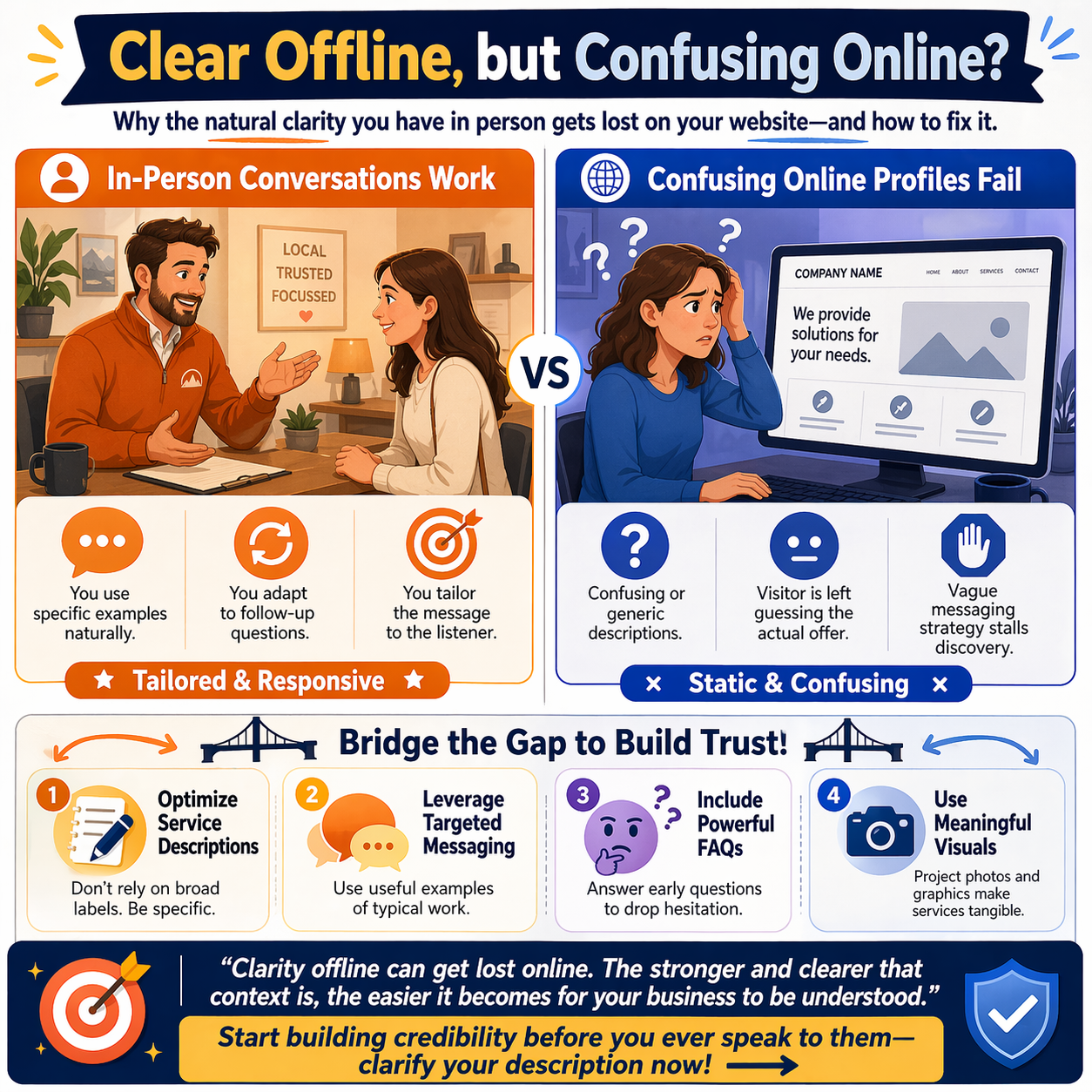
Why Your Business Is Easy to Understand Offline but Confusing Online
Many business owners explain their work well in person.
When asked, their answers are clear, natural, and tailored to the listener. They state clients, problems solved, and next steps.
However, when you visit their website or business profile, that in-person clarity is often replaced with confusing or generic descriptions. This disconnect is a main reason why businesses lose potential customers online. In this text, you will find practical, actionable steps to fix this common problem and make your business easier to understand online, just as it is offline.
The homepage says “trusted solutions” or “quality service.” The profile mentions the business name but does not explain the actual offer in a useful way. The services page feels broad, thin, or generic. Someone lands there hoping to quickly understand the business, but instead ends up guessing.
- This is how clarity offline can get lost online.
- Often, the challenge lies not in the business itself, but in how it is presented on the page.
- Why businesses often sound clearer in person
- This is partly because offline conversations have advantages that websites lack.
A customer can ask follow-up questions. You can notice the confusion and explain it differently. You can give an example based on the person in front of you. You can say, “We mostly help homeowners after storm damage,” or “Most of our clients are small law firms that need better case intake systems.”
This explanation is natural, flexible, and specific.
Online, the page must handle that work on its own; otherwise, the visitor is left with vague wording and missing context.
Online, your explanation must be planned in advance; if it's too broad, the conversation never begins.
Generic online language makes even a clear, trustworthy business sound vague and unreliable. This confusion stems from failing to apply the specificity and responsiveness of in-person explanations to web pages.
Many websites are not wrong—just too generic.
That is a problem because generic language sounds polished while saying very little.
A consulting firm writes that it offers "tailored business solutions." A roofing company says it provides "high-quality exterior services." A wellness center says it supports "better health outcomes." None of these lines is necessarily wrong. They just do not help a visitor understand what the business actually does.
Consider how these descriptions could be improved. For example, instead of "tailored business solutions," the consulting firm could say: "We help local manufacturers streamline inventory management and train staff to use more effective scheduling software." Rather than "high-quality exterior services," the roofing company might write: "We repair and replace shingle roofs for homeowners in Jackson and surrounding towns, including leak detection, gutter installation, and storm damage repairs." The wellness center could move beyond "better health outcomes" to: "We provide nutrition counseling, stress management workshops, and personalized exercise plans for adults looking to lower blood pressure or manage diabetes."
With these before-and-after examples, you can see how moving from broad, generic phrases to clear, specific descriptions gives potential customers the details they need to understand what you really offer.
Specific language works better because it reduces the reader's effort.
Compare these:
- “Tailored business solutions”
- “Operations consulting for small manufacturing businesses”
Or these:
- “Professional legal support”
- “Family-based immigration petitions, adjustment of status, and waiver support”
- The second version is more useful, not more impressive.
- Frequently, a business website starts with broad, professional-sounding wording that lacks precision.
- Vague service descriptions force visitors to guess
- People rarely enquire when they have to guess too much.
- A clear service page should answer basic questions without making someone search all over the site.
- What do you do?
- Who is it for?
- What kind of problem does it solve?
- What is included?
- What happens next if someone reaches out?
- Many businesses answer only a few of these, and often incompletely.
Take a cleaning company, for example. If the site says “residential and commercial cleaning services,” that still leaves a lot unclear. Does the business handle recurring cleaning, move-out cleaning, deep cleaning, office cleaning, post-construction cleaning, or all of them? Does it serve homeowners, landlords, offices, retail stores, or apartment managers? Is it limited to one city or several counties?
To make your own service descriptions clearer, try this quick exercise:
List out your primary services in detail.
Write down exactly who your ideal customers are.
Note the locations or areas you serve.
Then, use these points to rewrite your main business description so it is specific and easy to understand. For example: "We provide weekly and deep cleaning for homeowners and landlords in Dallas and Collin County, including move-out and post-construction jobs." This approach turns a vague label into a clear, practical summary for visitors.
The same issue appears in professional services. “Marketing support” could mean ads, social media, SEO, email, or content writing. If the page does not explain the real scope, visitors must fill in the blanks.
This disconnect—naming the service category without defining the offering—creates uncertainty in visitors, making the business difficult to understand online. Sharpening and specifying language is crucial to bridge the gap.
Many websites do not make this clear to their audience.
Another common problem is unclear audience targeting.
A business may know who it serves, such as small business owners or local families, but the website speaks to everyone. This dilutes the message and makes it hard for the ideal audience to recognize themselves in it.
A CPA may primarily work with small business owners but use language that sounds like it's meant for large corporations. A tutor may mainly help middle and high school students, but describes the service broadly, which could mean anything from preschool support to adult learning. A contractor serving homeowners may sound like a commercial vendor.
- Visitors quickly sense this, even if unspoken. They wonder if the business is really for them.
- A confusing profile usually results from not making the intended customer visible, not complexity.
- Real examples help people understand faster.
- Offline, business owners explain through examples all the time.
- They say: “We help families who need after-school math support.”
- “A lot of our work is for local businesses that need bookkeeping clean-up.”
- “Most of our remodeling projects involve kitchens, bathrooms, and room additions.”
- Such examples make the service concrete.
- Online, businesses often replace that clarity with broad claims, weakening the page. Visitors need enough detail to recognize the fit.
A tutoring page becomes stronger when it says the business helps with algebra, reading comprehension, homework support, and test preparation for specific grade levels. A law firm profile becomes easier to trust when it explains the types of cases it handles rather than simply calling itself “experienced and client-focused.”
Examples do not just add length. They clarify.
A lack of clarity online directly reduces trust and discourages inquiries, even when the business itself is capable. Bridging the gap between in-person and online explanations is essential for building trust.
Most visitors will not complain that your website is unclear.
They simply leave.
- Confusion is costly. It does not create visible feedback—it creates hesitation, reducing inquiries.
- When people do not understand what a business does, they often assume one of the following:
- The business may not be organized enough to explain itself clearly.
- The service may not be right for their situation.
- The process may become frustrating after contact as well.
- These assumptions form quickly, even if unfair.
- Visitors see your website as a signal. They want to know whether you understand your offer and your audience, and whether you communicate clearly. If not, trust falls.
- That is where a business's online problem becomes more than a writing issue. It starts affecting whether people feel comfortable reaching out at all.
- A complete business profile makes the business easier to understand
- A business profile should offer more than a name, phone number, and a few vague lines.
- It should help someone from your ideal audience understand the business without needing a live conversation first.
That usually means including:
- a clear description of what the business does
- specific services instead of broad labels alone
- service areas or locations
- Who the services are meant for
- useful examples of typical work
- contact details that are easy to find
- relevant photos, videos, or other media
- FAQs that answer early customer questions
This applies to websites, directory listings, and location-based business pages. The goal is not presence alone—it is being understandable.
For example, a landscaping company profile is stronger when it explains whether it handles design, installation, maintenance, irrigation, or seasonal clean-up, and clarifies if it serves homeowners, commercial clients, or property managers. A clinic profile is more useful when it clearly states its specialties, appointment methods, office hours, and the types of patients it serves, such as families, seniors, or children. A law firm profile is more trustworthy when its practice areas, office locations, case types, and the specific clients it serves—such as individuals, families, or businesses—are clearly explained. Retailers can clarify their offerings by specifying product types, in-store services, or loyalty programs, and noting whether they serve families, collectors, or local shoppers. Restaurants and cafes can strengthen their profiles by describing their menu focus, special dietary options, hours of operation, reservation policies, and whether they offer dine-in, takeout, or delivery, helping people quickly understand who they serve. Trade businesses like electricians or plumbers can make their profiles clearer by listing specific services (e.g., emergency repairs, routine maintenance, or installations), the locations served, the types of properties they handle, and any certifications, so customers know exactly what to expect.
A complete profile reduces guesswork and adds value.
FAQs help both people and digital platforms understand your business.
A useful FAQ section is often underestimated.
Many businesses treat FAQs as an optional extra, but they can do important work. First, they help real visitors. A person may want to know whether you serve a certain area, whether consultations are available, how long a process usually takes, or what information they should prepare before contacting you. When those answers are available, hesitation drops.
To make this even easier, here are some common FAQ questions that many small businesses can use as a starting point:
- What services do you offer?
- Which areas do you serve?
- Who are your typical customers?
- How do I request a quote or consultation?
- What is your process for new clients?
- What are your business hours?
- How much do your services cost, or how can I get a price estimate?
- Do you require appointments, or do you accept walk-ins?
- What payment methods do you accept?
- How quickly do you respond to inquiries?
- Are there any special requirements or information I should prepare before contacting you?
Including answers to these questions can make your page more helpful and reduce barriers for potential customers.
Second, FAQs also add clarity to the page itself. Search engines and AI-driven systems rely on clear, direct language to understand what a business does. Helpful FAQ answers can strengthen that understanding by explaining the service in the same way a real customer would ask about it.
If the answers are practical and well-written, they may also improve the chances that the page will be surfaced for relevant questions. In some situations, AI tools may pick up useful lines from those answers while directing users back to the source page. That does not mean every FAQ will produce visibility on its own, but it does mean FAQs should not be treated as filler.
They help readers and help platforms interpret the business more clearly.
Your business description matters more than many owners realize
Think of your main business description as more than just an introduction – it’s your chance to ensure both visitors and digital platforms clearly understand and trust what you do. A strong, well-clarified description opens the door to new clients and builds credibility before you ever speak to them. Take the time to make it unmistakably clear, and your business will gain stronger connections both online and offline. Ultimately, the clarity of your business description determines how well both people and digital systems understand what you offer.
Now, take a few minutes to review your own website or business profile. Is your language specific, clear, and targeted, or have you used broad phrases that might confuse visitors? Try reading your main description as if you were a first-time visitor. Make a list of any unclear points, missing details, or places where you could add specific examples. Even small improvements in clarity can make a real difference in how your business is understood and trusted online.
A vague description creates a vague signal. If your description is filled with broad phrases like “trusted partner,” “custom solutions,” or “committed to excellence,” but never explains your actual services, your page becomes harder to interpret.
A clear description does something much more useful. It tells readers and platforms what the business offers, who it helps, where it operates, and what makes the service relevant.
These matters because search engines and AI tools are not sitting with you in a live conversation. They are working from the words and context available on the page. The stronger and clearer that context is, the easier it becomes for your business to be understood and referenced properly.
That is one reason vague descriptions create a confusing business profile problem so quickly. They remove the substance that both people and platforms need.
- Visuals do more than make a profile look attractive.
- Many businesses add images simply to make the page look better.
- That is understandable, but visuals can do much more than that.
Useful visuals help explain the business faster. A short service video, an office walkthrough, a process graphic, a before-and-after project image, or a simple infographic can answer questions that a few broad sentences cannot. They make the service more tangible.
They can also support visibility. Google prioritizes useful visual content, especially when it effectively supports the page and is relevant to the business. Videos, informative graphics, project photos, and service-related images may create additional opportunities to appear in visual search results, including image search results. That is why visuals should not be seen only as decoration.
Of course, not every photo helps. Random stock images rarely add much. The visuals that matter are the ones that explain something real about your work.
A remodeling company can show the actual stages of a project. A training provider can show a classroom setup, training format, or snapshots of course materials. A legal or consulting business may use team photos, office visuals, and process graphics to make the experience easier to understand.
Good visuals do not replace clear writing. They support it.
Basic business details still matter more than people think.
Some pages look polished but still leave out the basics.
That creates unnecessary friction.
A visitor should not have to hunt for your service area, business hours, phone number, consultation method, office address, or the differences between services. These details seem small, but they help people make decisions.
If someone is deciding whether to contact you, practical clarity matters as much as presentation. A business can look professional yet feel incomplete if the page does not clearly answer simple questions.
An unclear business website often becomes clearer not by adding more words, but by adding the right details in the right places.
The goal is not to sound polished first. The goal is to be understood.
Many businesses make the same mistake online. They focus on sounding professional before being clear.
But most people are not looking for polished language. They are trying to determine whether your business meets their needs.
That means your website or profile should help them, without effort, understand what you do, who you help, what kind of work you handle, and why contacting you makes sense.
Offline, you may already have explained all of this very well. Online, that clarity needs to be visible on the page through specific descriptions, useful examples, strong FAQs, clear business details, and meaningful visuals.
That is the real reason a business can be easy to understand offline but confusing online. The business itself is not the problem. The online version simply does not explain the business with enough honesty, structure, and detail.
When people understand you clearly, trust can form. And without that first layer of understanding, even a very good business can be overlooked.